Engine Shop Visit Cost Trends in China 2026 | CFM56 V2500 LEAP Trent MRO
Engine Shop Visit Cost Trends in China 2026: CFM56, V2500, LEAP & Trent MRO
A comprehensive, data-backed look at engine shop visit costs, MRO facility capacity, and turnaround times in China for CFM56, V2500, LEAP, and Trent engines — with a market outlook through 2036.

China Engine MRO Market — Quick Facts
| China Engine-Overhaul MRO Segment (2024, implied) | ≈$5.0B |
| China Narrow-Body Engine Shop-Visit CAGR (2026–2036) | 6.8% |
| CFM56/LEAP Installed Base in China (late 2025) | 7,800+ engines |
| CFM56/LEAP China Narrow-Body Market Share | ≈70% |
| New-Parts Lead Times (industry-wide) | 12+ months |
| USM Cost Reduction vs. New OEM Parts | 30–50% |
| LEAP Overhaul Cost (Local, indicative) | $2M – $5M |
| Trent Overhaul Cost (Local, indicative) | $3M – $8M |
Sources: Grand View Research (China Aircraft MRO Market Outlook), FutureMarketInsights (Narrow-Body Turbofan Engine Shop Visit Services Market 2026–2036), GE Aerospace disclosures, Safe Fly Aviation Market Intelligence. Full citations in each section below.
Key Takeaways
- China's narrow-body engine shop-visit market is growing at 6.8% CAGR through 2036 — faster than the 5.5% global average — driven by 770 million domestic passengers in 2025 (FutureMarketInsights).
- Five real, verifiable China-based facilities now offer local engine MRO across the CFM56/LEAP, V2500, and Trent families: SSAMC (Chengdu), Ruihang Chongqing, BAESL (Beijing), Ameco Beijing, and the component/airframe ecosystem around GAMECO and TAECO.
- CFM56 and LEAP together power roughly 70% of China's narrow-body fleet (7,800+ engines in service, late 2025) — the dominant driver of shop-visit volume through at least 2035.
- Local shop visits can meaningfully undercut overseas repair costs and turnaround times, though the exact savings vary by engine type, workscope, and contract terms — see our full cost and turnaround comparison below.
- China's historic resistance to USM and PMA parts is shifting as new-parts lead times stretch past 12 months, pushing more operators toward used serviceable material that can cut parts costs 30–50%.
- Safe Fly Aviation provides engine MRO advisory, shop visit planning, MRO provider vetting, and cost benchmarking for operators and lessors in China and globally.
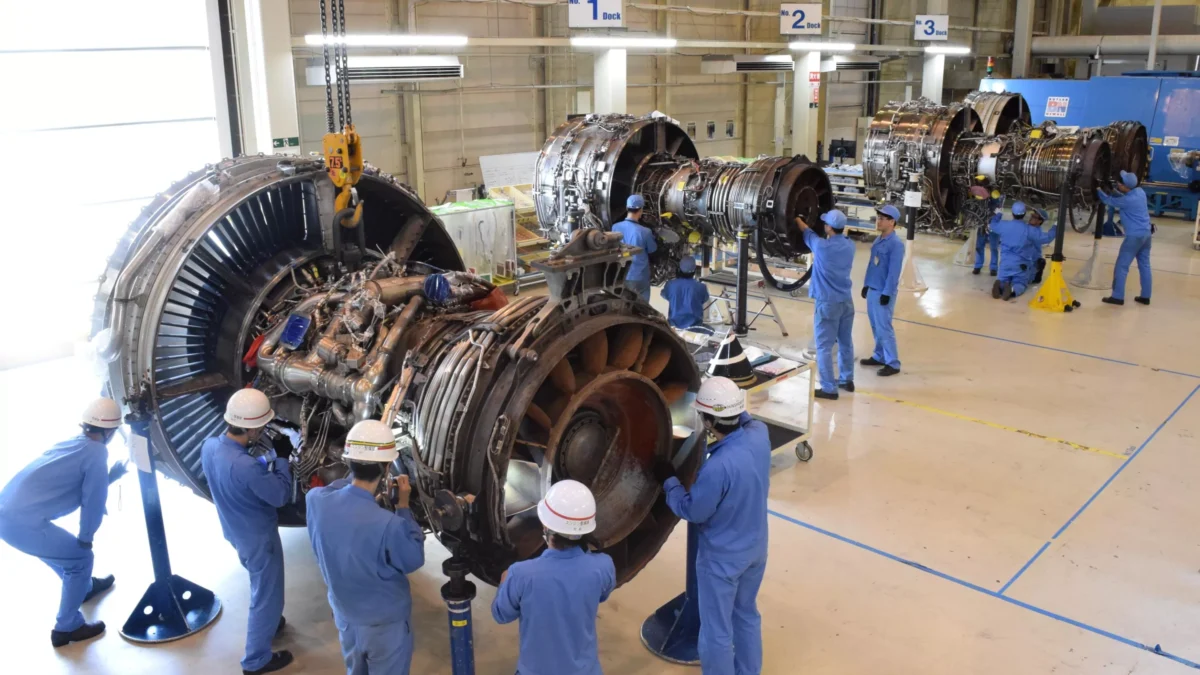
What is an engine shop visit? An engine shop visit is a scheduled maintenance event involving inspection, repair, replacement, and restoration of critical engine components. Shop visits typically occur at pre-determined intervals measured in flight cycles or hours, and range from minor module repairs (a "quick turn") to full performance-restoration overhauls that touch every major module.
Executive Summary: China Engine Shop Visit Market at a Glance (2026)
| China Aircraft MRO Market Size | $11.5B (2024) → $15.6B (2030) Source: Grand View Research, 5% CAGR 2025–2030 |
| Engine Overhaul Share of China MRO Revenue | 43.8% — the single largest MRO service category Source: Grand View Research, 2024 |
| China Narrow-Body Engine Shop-Visit CAGR | 6.8% (2026–2036), vs. 5.5% global average Source: FutureMarketInsights |
| CFM56/LEAP Installed Base & Orders | 7,800+ in service, ≈5,000 on order (combined) Source: GE Aerospace disclosures, late 2025 |
| Trent Widebody Local Capacity (New in 2025–26) | BAESL Beijing, ramping to 250 overhauls/year by 2034 Source: Rolls-Royce, Dec 2025 |
| Local Overhaul Cost Ranges (Indicative) | CFM56 $1.2M–$1.8M • V2500 $1.4M–$2.0M • LEAP $2M–$5M • Trent $3M–$8M Safe Fly Aviation Market Intelligence estimates |
| Global MRO Demand Backdrop | $136B (2025) → ≈$193B (2036), 3.3% CAGR — engine MRO is the largest & fastest-growing segment Source: Oliver Wyman Global Fleet & MRO Forecast 2026–2036 |
Data sources: Grand View Research, FutureMarketInsights, Oliver Wyman, GE Aerospace, Rolls-Royce, Safe Fly Aviation Market Intelligence. Full citations appear in each section below.
Contents
- Market Overview & Growth Forecast
- CFM56 Shop Visit Costs & Demand
- V2500 Maintenance Cost Trends
- LEAP Engine Overhaul Costs
- Trent Engine Shop Visit Costs
- Key Cost Drivers
- Local MRO Capacity Expansion
- Turnaround Time Trends
- Cost Comparison: Local vs Overseas
- LLP Economics & Reserve Planning
- Used Serviceable Material (USM) Market
- COMAC & Domestic Engine Development
- Forecast 2026–2036
- Safe Fly Engine MRO Advisory
- Frequently Asked Questions
Market Overview & Growth Forecast
China's aircraft MRO market reached $11.5 billion in 2024 and is projected to grow to $15.6 billion by 2030, a 5% compound annual growth rate, according to Grand View Research. Engine overhaul is the single largest service category within that market, capturing 43.8% of total MRO revenue in 2024 — implying an engine-overhaul segment of roughly $5.0 billion in China alone that year. China now represents approximately 12.7% of global aircraft MRO revenue.
Within the narrower category of narrow-body turbofan engine shop visits specifically, FutureMarketInsights' Global Narrow-Body Turbofan Engine Shop Visit Services Market report values the worldwide market at $17.9 billion in 2026, growing to $30.5 billion by 2036 (5.5% global CAGR). China's own country-level growth within that market is forecast at 6.8% CAGR — faster than the global average and second only to India's 7.4% — driven by rising domestic passenger volumes (770 million passengers in 2025) that push more aircraft into higher utilization and, in turn, more frequent engine shop visits.
Zooming out further, Oliver Wyman's Global Fleet and MRO Market Forecast 2026–2036 projects the worldwide commercial fleet growing from 30,046 to 41,135 aircraft (3.2% CAGR) and global MRO demand rising from $136 billion (2025) to roughly $193 billion by 2036 (3.3% CAGR) — with engine MRO identified as the largest and fastest-growing MRO segment worldwide. China is expected to add more aircraft than any other single market over the coming decade, reinforcing its role as one of the largest sources of future engine shop-visit demand.
CFM56 Shop Visit Costs & Demand

The CFM56 and its successor, the LEAP, together power an estimated 7,800+ engines in service in China as of late 2025, commanding roughly 70% of the domestic narrow-body market, with a combined order book of around 5,000 additional engines (GE Aerospace disclosures). With new CFM56-powered 737NG and A320ceo deliveries long since ended, the market has entered what industry commentary describes as a "more repair than sales" era — the installed base is aging into its heaviest shop-visit years, and keeping it flying reliably, rather than adding new units, is now the central story.
Indicative local overhaul costs for CFM56 shop visits in China run $1.2 million to $1.8 million, depending on workscope, life-limited parts (LLP) replacement, and whether the visit is a quick-turn repair or a full performance restoration (Safe Fly Aviation Market Intelligence estimates, broadly consistent with the global benchmarks in our Engine Shop Visit Costs Worldwide 2026 report). China's CFM56 support base is one of the most established of any engine type in the country: SSAMC in Chengdu was the first dedicated CFM56 MRO facility in China, operating since a 1999 joint venture between Air China and CFM International, and the newer Ruihang (Chongqing) Aircraft Engine Maintenance Co. is now also qualified on CFM56-5B/7B.
For a deeper look at CFM56-specific aftermarket economics, deal activity, and the broader "more repair than sales" narrative in China, see our dedicated CFM56 Engine Aftermarket in China (2026) analysis — this section focuses specifically on shop-visit cost and capacity trends rather than duplicating that deal-level coverage.
V2500 Maintenance Cost Trends

The V2500 — built by the International Aero Engines (IAE) consortium of Pratt & Whitney, Japanese Aero Engine Corporation, and MTU Aero Engines — continues to power a meaningful share of China's A320ceo-family fleet. As those aircraft mature, shop-visit demand for the V2500 remains steady rather than declining, since many operators are extending A320ceo service life to bridge delivery delays on new-generation replacements.
Ameco Beijing, the long-established Air China/Lufthansa Technik joint venture, has publicly indicated it expects growth in its engine overhaul business driven by demand for both the V2500 and the Rolls-Royce RB211 — two engine families with a large, aging installed base and limited alternative local overhaul options in China. Indicative local V2500 overhaul costs run $1.4 million to $2.0 million, broadly comparable to CFM56 given similar engine size and shop-visit scope, though exact pricing depends heavily on module condition and LLP life remaining at induction (Safe Fly Aviation Market Intelligence estimates).
LEAP Engine Overhaul Costs

The LEAP engine family is the fastest-growing segment of China's narrow-body engine population. LEAP-1A now powers an estimated 70% of China's A320neo fleet, and as the installed base matures past its initial deliveries, first-run shop visits are beginning to arrive in volume — a trend expected to accelerate sharply over the next five years as more engines reach their first hot-section inspection or performance-restoration interval.
Local LEAP overhaul costs are indicatively higher than CFM56 or V2500, at roughly $2 million to $5 million, reflecting the LEAP's more advanced materials (including ceramic matrix composites in the hot section) and, in China specifically, the fact that local LEAP shop-visit capability is newer and more limited than the decades-established CFM56 ecosystem. Ruihang (Chongqing) Aircraft Engine Maintenance Co. holds qualifications covering LEAP-1A/1B/1C alongside CFM56, and industry reporting on local capability points to local LEAP turnaround times in the region of 45 days versus three months or more for engines sent overseas — though, as with any indicative benchmark, actual turnaround varies by workscope, parts availability, and shop backlog at the time of induction.
Trent Engine Shop Visit Costs

Rolls-Royce's Trent family (Trent 700, Trent XWB-84, and Trent 1000) represents the widebody segment of China's engine shop-visit market, and until very recently it had no dedicated local overhaul option at all — every Trent shop visit required shipping the engine overseas. That changed with Beijing Aero Engine Services Limited (BAESL), a Rolls-Royce/Air China joint venture that officially opened on 10 December 2025 as China's first dedicated Trent engine overhaul facility, holding a CAAC Maintenance Organisation Certificate and becoming operational through 2026. BAESL is expected to ramp to 250 overhauls per year by 2034, and is one of only four Rolls-Royce-authorized joint-venture overhaul facilities worldwide.
Indicative local Trent shop-visit costs run $3 million to $8 million, reflecting the scale and complexity of widebody powerplants (Safe Fly Aviation Market Intelligence estimates). Even with BAESL now online, the local Trent MRO ecosystem remains far newer and shallower than China's narrow-body engine infrastructure, so operators should expect capacity to tighten as BAESL ramps toward full volume and demand from China's growing 787 and A350 fleets continues to build.
Key Cost Drivers
Shop-visit costs in China are shaped by the same fundamental drivers that apply globally — life-limited parts typically account for 40–60% of a shop visit's total parts bill, hot-section and HPT blade replacement drives much of the remaining cost variability, and labor rates and shop selection materially affect the total invoice. We cover that generic cost breakdown in full detail in What Determines Aircraft Engine Overhaul Costs?, so this section focuses on what's specifically different about China.
Domestic Labor Rates
China's technician labor rates remain competitive relative to European and North American shops, though rates are rising as skilled engine-MRO technicians are in short supply nationwide.
Parts Lead Times
New-parts lead times now regularly exceed 12 months industry-wide, pushing operators toward used serviceable material (USM) and local module-swap strategies to avoid extended aircraft-on-ground exposure.
Flight-Cycle Growth
770 million domestic passengers in 2025 mean higher aircraft utilization and more flight cycles per engine per year — directly increasing shop-visit frequency across the fleet.
Logistics & Customs
Local shop visits avoid the international shipping, customs clearance, and cross-border insurance costs that add both time and expense to an overseas repair.
Local MRO Capacity Expansion
China's local engine MRO footprint has expanded meaningfully over the past two years. Five facilities now anchor the country's engine shop-visit capability across the CFM56/LEAP, V2500, and Trent families:
SSAMC
Sichuan Services Aero-Engine Maintenance Company — an Air China/CFM International joint venture operating since 1999. The first dedicated CFM56 MRO facility in China, and the first in the country to offer LEAP maintenance. 40,000 m² of floorspace; CAAC, EASA, and FAA approved.
Ruihang (Chongqing) Aircraft Engine Maintenance Co.
A joint venture of Switzerland-based SRT, US-based GE, and China's HNA Aviation Group. Launched April 2025; qualified on CFM56-5B/7B and LEAP-1A/1B/1C. Chongqing's first civil aero-engine maintenance base and China's seventh comprehensive local engine-MRO location. Targeting 100 overhauls in its first year, with Phase II designed for 300+ heavy overhauls annually by 2027.
BAESL
Beijing Aero Engine Services Limited — a Rolls-Royce/Air China joint venture and China's first dedicated Trent overhaul facility (Trent 700, Trent XWB-84, Trent 1000). Opened 10 December 2025; ramping toward 250 overhauls/year by 2034.
Ameco Beijing
A long-established Air China/Lufthansa Technik joint venture. Publicly indicated growth expectations for its V2500 and Rolls-Royce RB211 overhaul business as demand for those aging engine families continues.
GAMECO & TAECO (HAECO Xiamen)
GAMECO (Guangzhou, China Southern/Hutchison JV since 1989) and TAECO (Xiamen, HAECO/Cathay Pacific/JAL JV since 1993) are major airframe and component MRO providers that round out China's broader maintenance ecosystem, supporting engine shop visits with parts, component repair, and line-maintenance infrastructure.
Turnaround Time Trends
As local capacity has come online, turnaround times for China-based engine shop visits have improved relative to sending an engine overseas — though the industry-wide picture is mixed, and Asia-Pacific turnaround times generally have lengthened compared to pre-pandemic norms as shop backlogs and parts shortages persist across the region.
| Engine Family | Local Turnaround (Indicative) | Typical Overseas Turnaround |
|---|---|---|
| LEAP | ≈45 days | 3+ months |
| CFM56 | 60–90 days | 90–120+ days |
| V2500 | 60–90 days | 90–120+ days |
| Trent | 90–120 days | 120–180+ days |
These figures are Safe Fly Aviation Market Intelligence estimates based on publicly reported facility capability and industry commentary; actual turnaround depends heavily on workscope, parts availability, and each shop's backlog at induction. As Ruihang Chongqing's Phase II capacity and BAESL's ramp toward 2034 volumes come online, we'd expect the local-vs-overseas gap to narrow further for LEAP, CFM56, and Trent engines respectively — though V2500 capacity remains comparatively limited given the type's declining production status.
Cost Comparison: Local vs Overseas
Local shop visits in China can offer meaningful cost advantages over sending an engine overseas, primarily by avoiding international shipping, customs clearance, and cross-border insurance, and by taking advantage of competitive domestic labor rates.
| Engine Family | Indicative Local Savings vs. Overseas | Primary Drivers |
|---|---|---|
| LEAP | 30–50% | Avoided shipping/customs; newer local capacity still scaling |
| CFM56 | 20–30% | Mature, competitive local ecosystem (SSAMC, Ruihang Chongqing) |
| Trent | 20–40% | New BAESL capacity avoids overseas shipping for large widebody engines |
These are indicative ranges from Safe Fly Aviation Market Intelligence, not third-party-verified statistics — actual savings depend on the specific shop, workscope, contract terms (including power-by-the-hour agreements), and whether LLP replacement is required. We'd encourage any operator evaluating local vs. overseas MRO to request comparable quotes for their specific engine's condition rather than relying on industry-wide averages alone.
LLP Economics & Reserve Planning
Life-limited parts (LLPs) — discs, blades, seals, and other components with hard cycle limits — are consistently the single largest cost driver in any engine shop visit, typically representing 40–60% of the total parts bill. This holds true in China exactly as it does globally, but two local factors shape LLP economics specifically here: first, imported LLPs face the same 12+ month lead times affecting new parts generally, making reserve planning and induction-date forecasting especially important; second, China's growing local USM market (see below) is beginning to offer an alternative sourcing channel for LLPs with remaining cycle life, at a discount to new-part pricing.
For a full methodology on LLP valuation, depreciation curves, and reserve planning — including our LLP tracking dashboard framework and purchase-decision flow — see our dedicated guide: Aircraft Engine LLP Management: Complete Guide for Owners, Lessors & Operators. Operators inducting engines at any of China's local facilities should confirm LLP stack status and remaining cycles well in advance, since parts availability — not shop capacity — is now the more common source of schedule slippage.
Used Serviceable Material (USM) Market
Used serviceable material (USM) — life-limited parts, quick-engine-change kits, and module exchanges sourced from teardown engines — can reduce maintenance costs by 30–50% compared to new OEM parts, and is one of the fastest-growing cost-management levers available to operators facing today's extended new-parts lead times.
China has historically been slower than Western markets to adopt USM and PMA (Parts Manufacturer Approval) components, reflecting both regulatory caution and a preference for OEM-sourced parts. That is now changing: industry commentary describes "a step change happening in China," with more Chinese airlines beginning to see PMA and USM as legitimate cost-control tools rather than a compromise on quality — a meaningful shift given how long the market had resisted it. As new-parts lead times stretch past 12 months and shop-visit volumes rise across CFM56, LEAP, V2500, and Trent fleets alike, USM sourcing is likely to become a larger part of how Chinese operators manage engine maintenance budgets over the rest of this decade.
For more on the CFM56-specific USM opportunity in China, including recent teardown economics, see the "Used Serviceable Material" section of our CFM56 Engine Aftermarket in China (2026) report, and our LLP Management Guide for how USM interacts with LLP reserve planning specifically.
COMAC & Domestic Engine Development

No analysis of China's engine market is complete without addressing the country's domestic propulsion ambitions. The CJ-1000A, developed by the Aero Engine Corporation of China (AECC), is intended to eventually reduce COMAC's reliance on the LEAP-1C for the C919 narrow-body programme. As of this update, AECC continues flight testing the CJ-1000A on a Y-20 testbed and on C919 prototypes; certification targets remain fluid, with industry consensus pointing to 2027–2028 for initial entry into service, subject to test results and regulatory approval.
Importantly for the shop-visit and MRO market specifically: the CJ-1000A does not replace China's existing CFM56-powered 737 and A320ceo fleets, and even as it matures, the already-delivered LEAP-1C fleet will still require decades of ongoing support. The CFM56 installed base is expected to remain the dominant engine-MRO driver in China through at least 2035. We'd frame the CJ-1000A as a factor that will shape long-term fleet-planning and engine-acquisition decisions over the next 5–10 years — not an imminent disruption to today's shop-visit economics. For deal-level detail on how this is affecting CFM56/LEAP aftermarket strategy today, see our CFM56 Aftermarket in China (2026) report.
Forecast 2026–2036
Taken together, the data points to sustained, above-global-average growth in China's engine shop-visit market through the next decade. China's narrow-body engine shop-visit segment is forecast to grow at 6.8% CAGR (2026–2036) — outpacing the 5.5% global average — while China's overall aircraft MRO market grows at a more moderate 5% CAGR through 2030, with engine overhaul remaining its largest single revenue category throughout.
On the supply side, local capacity is still catching up to demand rather than running ahead of it: Ruihang Chongqing's Phase II expansion (targeting 300+ heavy overhauls/year by 2027) and BAESL's ramp toward 250 Trent overhauls/year by 2034 both suggest the local-vs-overseas cost and turnaround gap should continue narrowing gradually rather than closing abruptly. Meanwhile, the CJ-1000A's 2027–2028 target entry into service will not meaningfully affect shop-visit volumes this decade, since the existing CFM56/LEAP installed base of 7,800+ engines will still require full-life maintenance support regardless of how quickly domestic engine production scales. We expect the 2026–2036 period to be defined by capacity expansion, rising USM/PMA adoption, and gradually improving local turnaround times, rather than any single disruptive shift.
Safe Fly Engine MRO Advisory
Navigating engine shop-visit decisions in a market with rapidly evolving local capacity, shifting cost dynamics, and multiple engine families in play requires more than a single benchmark figure. Here's how Safe Fly Aviation supports operators and lessors with engines flying — or maintained — in China.
Shop Visit Planning
Induction-date forecasting, workscope planning, and LLP reserve alignment tailored to your fleet's specific engines.
Cost Benchmarking
Independent, data-backed comparison of local vs. overseas shop-visit quotes across CFM56, V2500, LEAP, and Trent engines.
MRO Provider Vetting
On-the-ground assessment of China-based facility capability, certifications, and current backlog before you commit an engine.
USM Sourcing
Access to vetted used serviceable material and teardown parts to manage cost and lead-time pressure on your next shop visit.
LLP Management
Independent LLP valuation and tracking to keep reserve planning accurate as parts change hands and cycles accrue.
Global Network, Local Insight
15+ years of aviation advisory experience combined with current, on-the-ground knowledge of China's fast-changing MRO landscape.
Need Engine MRO Support in China?
Safe Fly Aviation provides expert engine MRO advisory, shop visit planning, and cost benchmarking for CFM56, V2500, LEAP, and Trent engines. Our team delivers practical, data-driven solutions tailored to your fleet needs.
Global: +91 98116 73015 · India: +91 7840 000 473
Email: info@safefly.aero
WhatsApp an Engine MRO SpecialistFrequently Asked Questions About Engine Shop Visit Costs in China
What are the current engine shop visit cost trends in China?
Engine shop visit costs in China are rising due to increased flight cycles, extended parts lead times (now regularly 12+ months), and labor-rate inflation. CFM56 shop visits remain the highest-volume segment given the size of the installed base, while LEAP and Trent visits are the fastest-growing as those fleets mature into their first heavy shop-visit years. China's narrow-body engine shop-visit market is projected to grow at 6.8% CAGR through 2036 (FutureMarketInsights), driven by China's expanding domestic fleet and rising passenger volumes.
How much does a LEAP engine overhaul cost in China?
A LEAP engine overhaul indicatively costs between $2 million and $5 million, depending on scope, LLP replacement, and labor requirements. With local MRO capability now available at SSAMC (Chengdu) and Ruihang (Chongqing) Aircraft Engine Maintenance Co. — both qualified on LEAP-1A/1B/1C — airlines can reduce costs and turnaround times compared to sending engines overseas.
What is the cost of a Trent engine shop visit in China?
Trent engine shop visits (Trent 700, Trent XWB-84, Trent 1000) indicatively range from $3 million to $8 million depending on workscope. BAESL, the Rolls-Royce/Air China joint venture in Beijing that opened in December 2025, is China's first dedicated Trent overhaul facility, reducing shipping costs and logistics time for operators who previously had no local option.
How long does an engine shop visit take in China?
Local MRO facilities in China can indicatively complete shop visits in around 45 days for LEAP engines, compared to three months or more for engines sent overseas. CFM56 and V2500 visits typically take 60–90 days locally, and Trent visits 90–120 days. These are Safe Fly Aviation Market Intelligence estimates — actual turnaround varies by workscope, parts availability, and shop backlog, and Asia-Pacific turnaround times generally have lengthened industry-wide compared to pre-pandemic norms.
Which engine families have the highest shop visit demand in China?
CFM56 and LEAP together account for roughly 70% of narrow-body engine market share in China, with 7,800+ engines in service as of late 2025 (GE Aerospace disclosures). V2500 demand remains steady as A320ceo aircraft are kept flying longer. Among wide-body engines, the Trent family (Trent 700, Trent XWB-84, Trent 1000) is the fastest-growing segment now that BAESL provides local overhaul capability.
What is the market growth forecast for engine MRO in China?
China's narrow-body turbofan engine shop-visit services market is projected to grow at 6.8% CAGR from 2026 to 2036 (FutureMarketInsights), faster than the 5.5% global average. China's broader aircraft MRO market is projected to grow from $11.5 billion (2024) to $15.6 billion by 2030, a 5% CAGR, with engine overhaul remaining the largest single service category (Grand View Research).
What is the cost difference between local and overseas engine MRO in China?
Local MRO facilities can offer significant indicative cost savings: LEAP overhauls roughly 30–50% cheaper, CFM56 overhauls roughly 20–30% cheaper, and Trent overhauls roughly 20–40% cheaper compared to overseas repairs. Savings are primarily driven by avoided international shipping and customs costs, lower logistics overhead, and competitive local labor rates — though actual savings vary by shop, workscope, and contract terms.
Can Safe Fly Aviation help with engine shop visit planning in China?
Yes. Safe Fly Aviation provides comprehensive engine MRO advisory services, including shop visit planning, cost benchmarking, MRO provider vetting, USM sourcing, and LLP management for operators and lessors with engines flying or maintained in China. Contact our team for tailored support.
Related Safe Fly Aviation Resources
Methodology & Sources: Synthesized from Grand View Research (China Aircraft MRO Market Outlook), FutureMarketInsights (Global Narrow-Body Turbofan Engine Shop Visit Services Market 2026–2036), Oliver Wyman (Global Fleet and MRO Market Forecast 2026–2036), GE Aerospace and Rolls-Royce public disclosures, Aviation Week, and Safe Fly Aviation Market Intelligence, current as of 20 September 2026. Indicative cost and turnaround figures are Safe Fly Aviation estimates unless otherwise attributed, and are subject to change; contact us for a quote specific to your engine and workscope.
© 2026 Safe Fly Aviation — Informational purposes only. Not investment or maintenance-planning advice. Contact info@safefly.aero for personalized consultation.
Updated 20 September 2026