Why Delhi & Mumbai Are the Hardest Airports for Business Jets
Why Delhi & Mumbai Are the Hardest Airports for Business Jets
For private jet and charter travellers, Delhi and Mumbai can be the most operationally challenging airports in India. Here's what actually makes them difficult—and how to plan around the constraints.

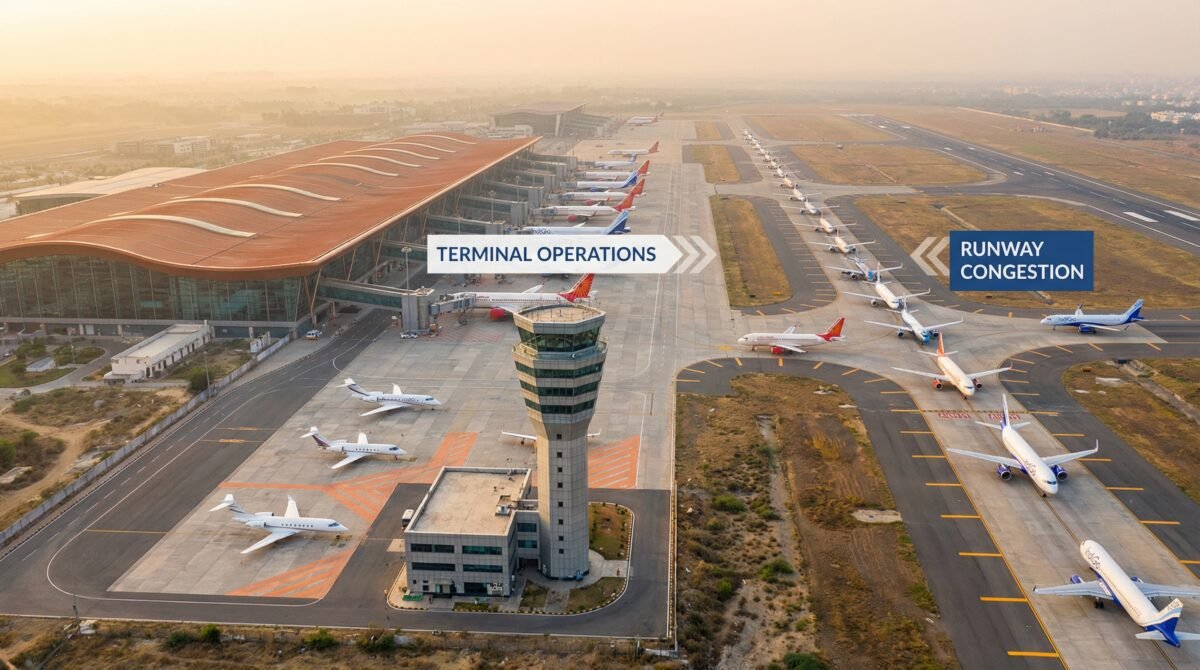
Delhi (DEL) and Mumbai (BOM) are two of India's most important aviation gateways, handling millions of passengers annually and serving as critical hubs for both domestic and international connectivity. They also tend to be the most operationally difficult for business jets when it comes to securing preferred arrival and departure timings, reliable parking, and operational flexibility.
The reason is not a single rule or restriction. It is the combination of high airport utilisation, strict slot coordination systems, limited general aviation (GA) parking infrastructure, and operational prioritisation during constrained periods. Understanding these factors helps operators and corporate travellers plan more effectively.
1) High Utilisation: The Airport Is Already Near Capacity
Both airports handle high-frequency airline movements for extensive domestic and international networks. Delhi serves as a major connecting hub for North India and international routes, while Mumbai is the primary gateway for Western India and a critical business aviation hub.
When runway and terminal systems run near maximum throughput—especially during peak morning and evening windows—any additional demand, including private jets, must fit into limited available slots. This creates natural constraints on timing flexibility and increases the need for advance coordination.
2) Slot Coordination: Timings Are the Currency
At slot-coordinated airports like DEL and BOM, timing is not simply a preference; it is an operational allocation. Slots are assigned based on available capacity, and both arrival and departure windows must be approved in advance.
Private flights may face reduced flexibility during peak windows (typically early morning departures and evening arrivals), and minor schedule changes can trigger re-coordination requirements that may result in less favorable timing or operational delays.
Best practice: Request slots as early as possible (5–7 working days recommended) and provide realistic time windows rather than single-point timings to improve approval likelihood.
3) Parking Constraints: Landing Is Not the Same as Staying
A frequent misconception among private jet travellers is that if you can land, you can park. In practice, general aviation apron space at both DEL and BOM is significantly limited compared to commercial aircraft parking.
Overnight parking may be restricted due to space constraints, especially during high-traffic periods such as festive seasons, major events, or when weather disruptions cause congestion recovery. If parking is unavailable, operators may need to reposition the aircraft to an alternate airport after passenger drop-off, adding operational complexity and cost.
Key insight: Always confirm parking availability separately from landing clearance, and have a repositioning plan ready if overnight parking cannot be secured.
4) Priority Stacking: Scheduled Operations and Essential Movements
During constrained periods—peak hours, weather events, or congestion recovery—airports typically prioritise scheduled airline flows and essential movements (medical, government, emergency operations).
This prioritisation does not "ban" business jets, but it can reduce the availability of ideal slot times and increase the likelihood that private jet movements are assigned to off-peak windows or experience delays during peak demand periods.
5) Disruption Recovery: Weather and Congestion Cascades
When operational disruption occurs—whether due to weather, visibility constraints, runway maintenance, or system congestion—the airport focuses on stabilising the schedule and clearing backlogs. This recovery window can significantly affect private movements through slot shifts, delays, or reduced parking availability.
Delhi, in particular, experiences seasonal fog during winter months that can cause major disruptions and limit visibility operations. Mumbai faces monsoon-related challenges. Both scenarios create ripple effects that impact business jet scheduling for days afterward.
How to Plan Smarter for DEL and BOM
Given these operational realities, here are practical strategies for successful business jet operations at Delhi and Mumbai:
- Request slots early and share realistic time windows (not single-point timings) to improve approval flexibility
- Confirm parking separately from landing clearance and plan for aircraft repositioning if required
- Consider alternate airports where operationally sensible for ground access and timing flexibility (e.g., nearby regional airports for certain routes)
- Avoid last-minute schedule changes that may require re-coordination and result in less favorable slots
- Build buffer time for peak windows and disruption recovery periods—especially during winter fog season (DEL) and monsoon season (BOM)
- Work with experienced India-based operators familiar with airport-specific constraints and coordination procedures
- Have contingency plans for both timing adjustments and parking repositioning scenarios
- Monitor weather forecasts closely during known disruption seasons and adjust plans proactively
The Bottom Line
Delhi and Mumbai remain essential gateways for business aviation in India, but successful operations require understanding that capacity constraints are real, parking is limited, and flexibility is valuable. The operators who plan earliest, communicate clearly, and maintain operational flexibility tend to have the smoothest experiences at these high-utilisation airports.
Editorial note: This explainer describes widely observed operational constraints at high-utilisation airports based on industry experience and operator feedback. Specific conditions can vary by date, time window, season, and airport-level coordination decisions. Always verify current slot and parking availability with airport authorities and experienced ground handlers before finalising travel plans.