Latest Trends in Aircraft Jet Engine Technology – Innovation, Efficiency, and the Future of Aviation
Latest Trends in Aircraft Jet Engine Technology: Innovation, Efficiency & the Future of Aviation
The aviation industry is undergoing its most significant propulsion revolution in decades — geared turbofans, sustainable fuels, hydrogen power, ceramic composites, and AI-driven digital twins are reshaping every aspect of how aircraft are powered. A comprehensive 2025–2026 guide by Safe Fly Aviation.
Introduction: The Propulsion Revolution
The aviation industry stands at the threshold of a revolutionary transformation, driven by groundbreaking advancements in aircraft jet engine technology. As global air travel continues to grow and environmental sustainability becomes paramount, jet engines — the beating heart of modern aviation — are evolving at an unprecedented pace. These innovations are not merely incremental improvements; they represent fundamental shifts in how we approach aircraft propulsion, promising to deliver enhanced fuel efficiency, reduced emissions, and improved operational reliability.
With aviation responsible for approximately 2.5% of global carbon emissions and demand for air travel continuing to rise, the industry faces mounting pressure to develop next-generation engines that deliver both performance and environmental responsibility. Leading manufacturers — Pratt & Whitney, GE Aerospace, Rolls-Royce, and CFM International — are investing billions in research to create propulsion systems that will power a sustainable aviation future.
📊 The Scale of the Challenge
Aviation emits approximately 900 million tonnes of CO₂ annually. Achieving the industry’s net-zero 2050 target requires cutting emissions by over 700 million tonnes per year from current levels — equivalent to eliminating the entire annual emissions of France, Germany, and the UK combined. New engine technology is the single largest lever available.
Fuel Efficiency & Emissions Reduction: The New Efficiency Paradigm
The past decade has seen extraordinary advances in propulsion efficiency. The chart below illustrates the evolution of fuel efficiency improvements across major commercial engine generations:
Fuel Efficiency Improvement by Engine Generation vs. 1990 Baseline (%)
Cumulative improvement in specific fuel consumption (SFC) relative to 1990-era high-bypass turbofans
📊 Sources: Pratt & Whitney, IATA, ICAO CAEP. Figures represent specific fuel consumption improvement vs 1990 baseline.
GTF Engine vs Previous Generation: Key Metrics
Pratt & Whitney PW1100G-JM versus CFM56-5B (A320ceo baseline)
📊 Source: Pratt & Whitney GTF programme data
SAF Lifecycle GHG Reduction Potential (%)
By feedstock type versus conventional jet fuel (lifecycle basis)
📊 Sources: ICAO CORSIA, IATA, Rocky Mountain Institute
Geared Turbofan (GTF) Engines: The Efficiency Breakthrough
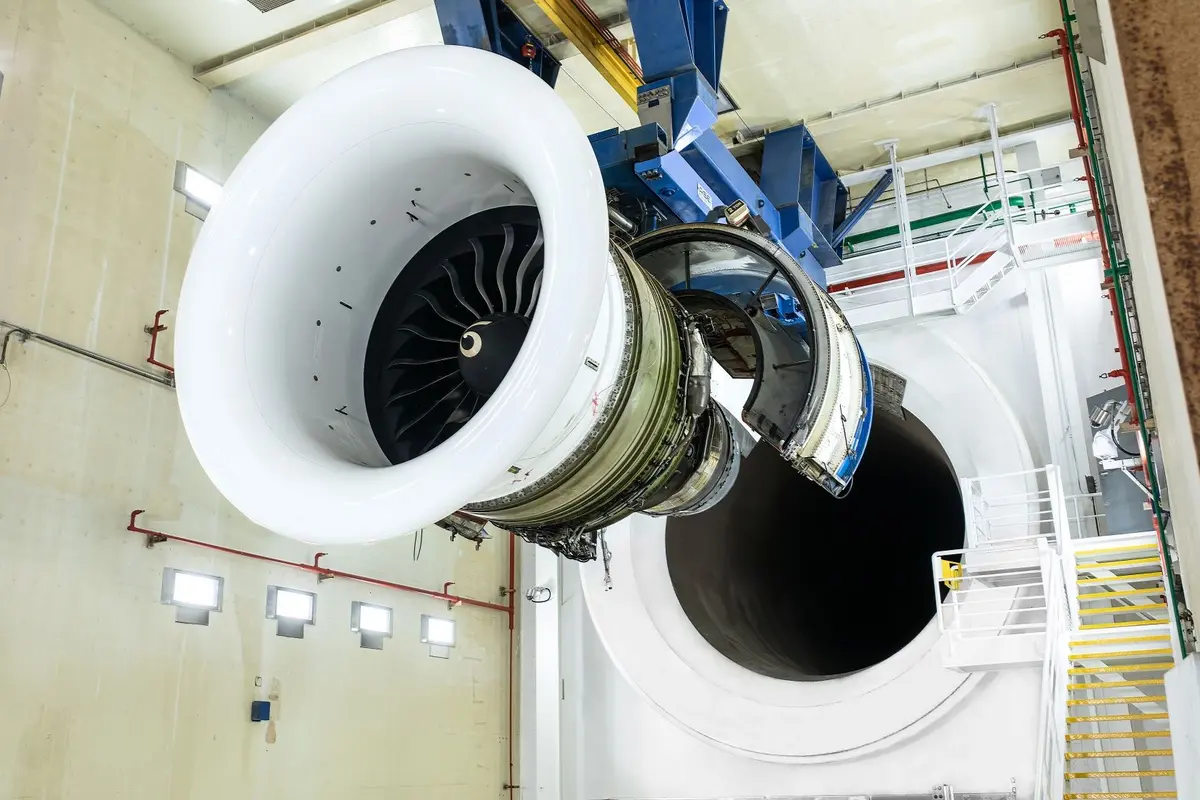
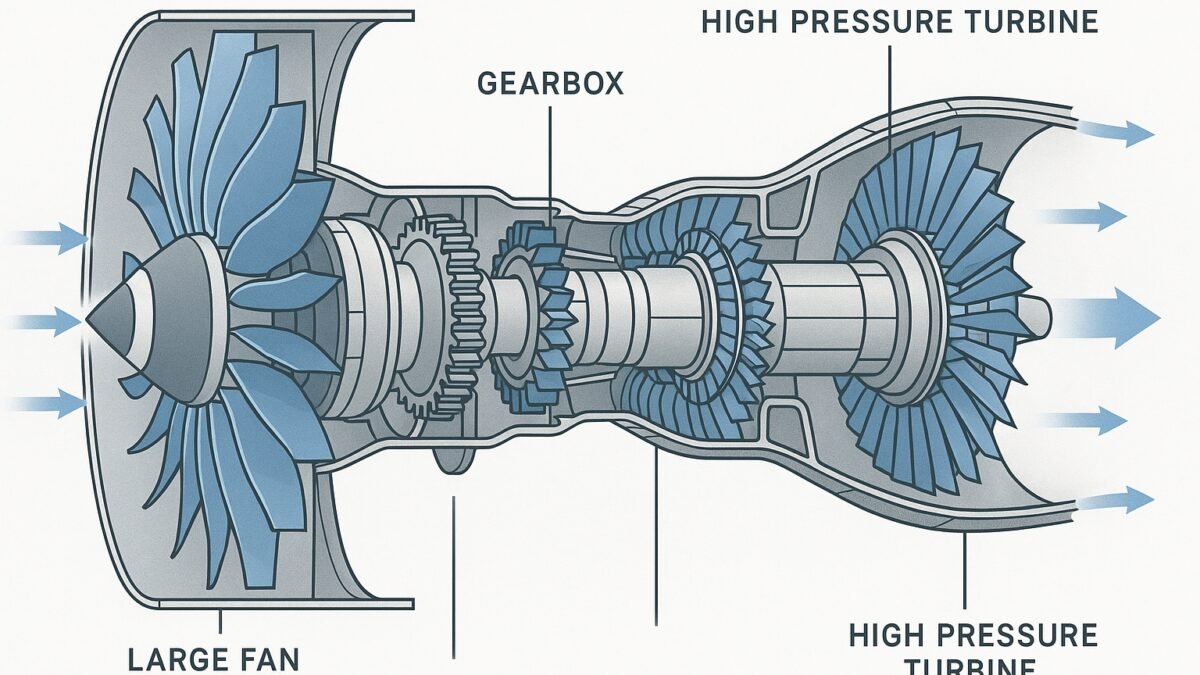
The geared turbofan engine represents one of the most significant breakthroughs in modern aviation propulsion. The revolutionary gear system allows the fan and low-pressure turbine to operate at their optimal speeds independently, delivering unprecedented efficiency gains. Unlike conventional turbofans where the fan and low-pressure turbine are mechanically coupled and forced to rotate at the same speed, the GTF’s reduction gearbox enables each component to spin at its ideal rate — the fan at a relatively slow speed for aerodynamic efficiency, and the turbine at a much higher speed for thermodynamic efficiency.
Pratt & Whitney GTF Engine: Performance Achievements
- 16% reduction in fuel consumption compared to previous-generation CFM56 engines on the A320ceo
- 75% reduction in noise footprint — dramatically reducing community noise impact around airports
- 50% reduction in NOx emissions contributing to improved air quality around airports
- GTF Advantage engine: delivers 4–8% more takeoff thrust whilst maintaining superior fuel efficiency, enabling new route economics
- Lower maintenance costs through improved component durability and extended on-wing time
The latest evolution, the GTF Advantage engine, takes efficiency even further by delivering 4–8% more takeoff thrust whilst maintaining superior fuel efficiency. This enhanced performance enables airlines to access new destinations and carry higher payloads, fundamentally changing route economics for narrowbody operations.
Ultra-High Bypass Ratio Engines
The trend toward ultra-high bypass ratio (UHBR) engines continues to drive significant efficiency improvements. These engines, with bypass ratios exceeding 12:1, reduce specific fuel consumption and noise emissions compared to traditional designs. Current generation engines like the LEAP-1A and PW1100G-JM demonstrate the potential:
- 15–20% fuel efficiency improvement over previous generation engines
- Reduced engine maintenance costs through improved durability and component life
- Lower operational noise supporting airport noise reduction initiatives worldwide


Current Generation Engine Comparison
| Engine | Manufacturer | Platform | Bypass Ratio | Fuel Saving vs Prior Gen | Status |
|---|---|---|---|---|---|
| PW1100G-JM (GTF) | Pratt & Whitney | A320neo | 12:1 | 16% | In Service |
| LEAP-1A | CFM International | A320neo | 11:1 | 15% | In Service |
| LEAP-1B | CFM International | 737 MAX | 9:1 | 14% | In Service |
| GEnx-1B | GE Aerospace | 787 | 9.6:1 | 20% | In Service |
| Trent XWB-84 | Rolls-Royce | A350-900 | 9.3:1 | 15% | In Service |
| RISE Open Fan | CFM International | New narrowbody | >20:1 | 20%+ | Development |
| UltraFan | Rolls-Royce | Future platforms | >15:1 | 25%+ | Demonstrator |
Sustainable Aviation Fuel (SAF): The Bridge to Net-Zero
Sustainable Aviation Fuel represents the most immediately deployable pathway toward carbon-neutral aviation. Modern jet engines are increasingly designed to operate seamlessly with SAF, which can reduce greenhouse gas emissions by up to 80% over their lifecycle compared to conventional jet fuel. Unlike hydrogen or electric alternatives that require fundamental aircraft redesign, SAF is a “drop-in” fuel — compatible with existing aircraft, engines, and infrastructure.
SAF Integration Advantages
- Immediate emissions reduction without requiring new aircraft or engine types
- Drop-in compatibility with existing fuel infrastructure — approved for blends up to 50% today
- Cleaner combustion with fewer particulate and sulphur emissions compared to fossil jet fuel
- Multiple pathways: produced from biomass, agricultural waste, municipal solid waste, and captured carbon via Power-to-Liquid (PtL)
- Airbus targeting 100% SAF compatibility across all new aircraft designs by 2030
- ICAO CORSIA framework driving adoption through blending mandates across member states
The fundamental challenge with SAF is production scale and cost. In 2024, SAF represented less than 0.5% of global jet fuel consumption, despite offering the largest near-term emissions reduction lever. Closing the cost gap between SAF (2–5× the cost of conventional jet fuel) and fossil kerosene requires policy support, infrastructure investment, and technology scale-up across the full production chain.

Hybrid-Electric & Hydrogen Propulsion: The Next Frontier
Alternative Propulsion Technology Readiness & Market Entry Timeline
Indicative entry-into-service windows for emerging propulsion technologies by aircraft category
📊 Sources: Airbus ZEROe programme, GE Aerospace, RTX, IATA Technology Roadmap 2025
Progress in Hybrid-Electric Jet Engines
Hybrid-electric propulsion represents a transformative approach to aircraft power generation. GE Aerospace has successfully demonstrated a hybrid-electric propulsion system rated at one megawatt, marking a significant milestone in next-generation propulsion development. RTX’s hybrid-electric flight demonstrator has achieved complete power testing milestones, combining highly efficient Pratt & Whitney engines with battery-powered electric systems.
Hybrid-Electric Systems
Combine conventional turbofan cores with electric motor-generators, enabling electric assist during critical phases (takeoff, climb) and energy recovery during descent.
- Up to 5% fuel reduction through optimised energy management
- Enhanced operational flexibility with multiple power sources
- Reduced emissions during critical flight phases
- GE Aerospace 1 MW demonstrator achieved in 2024
- Regional aircraft most near-term viable target
Hydrogen Combustion
Burns liquid hydrogen in a modified gas turbine engine, producing water vapour rather than CO₂. Requires modified fuel systems and combustion chambers.
- Zero CO₂ emissions from combustion
- Airbus ZEROe targets 100-seat aircraft by 2035
- Partners with MTU Aero Engines on fuel cell tech
- Requires cryogenic liquid hydrogen infrastructure
- Energy density per kg superior to batteries
Hydrogen Fuel Cells
Hydrogen reacts with oxygen in a fuel cell to generate electricity, which powers electric motors. Produces only water vapour as a by-product.
- ZEROe fuel cell powered-on at 1.2 MW in 2024
- 100-seat design with four 2-MW electric engines
- Higher efficiency than combustion approaches
- Greatest infrastructure challenge: airport H₂ distribution
- Partnership with Air Products for H₂ supply chain
All-Electric (Regional)
Battery-powered electric aircraft for short-haul and regional routes. Energy density constraints currently limit range and payload for commercial operations.
- Viable for routes under ~500 km today
- Zero direct emissions during operation
- Best suited to island-hop and commuter routes
- Certification progress: Heart Aerospace ES-30
- Battery energy density improving 5–8% annually
⚠️ Scaling Challenges
While the potential of alternative propulsion is enormous, significant challenges remain: battery energy density limitations; hydrogen storage and airport distribution infrastructure; certification and safety protocols for new propulsion architectures; and economic viability versus conventional engines at scale. The industry is addressing these through collaborative research programmes and phased implementation strategies.
Advanced Materials & Aerodynamics: Engineering for Performance
Ceramic Matrix Composites (CMCs)
Ceramic Matrix Composites represent a paradigm shift in engine materials technology. These advanced materials can withstand temperatures 300–400°F (165–220°C) higher than traditional metal alloys while being up to 30% lighter. GE Aerospace has been pioneering CMC technology for over 15 years, integrating them into production engines across its portfolio.
Engine Hot-Section Material Properties: CMC vs Traditional Alloys
Comparative performance across key engineering parameters (relative scale, higher = better performance)
📊 Sources: GE Aerospace CMC programme, NACA technical reports, materials science literature
CMC applications in modern engines include: turbine shrouds and vanes operating at extreme temperatures; combustor components enabling higher operating temperatures; and weight reductions of up to 30% compared to metal alternatives — directly improving specific power and reducing fuel burn.

Composite Fan Blades
The development of composite fan blades has enabled larger, more efficient engine designs. Rolls-Royce’s UltraFan demonstrator features the world’s largest fan blades, manufactured using advanced carbon fibre composite materials. These blades offer reduced weight compared to titanium alternatives, enhanced durability under extreme operational conditions, and improved aerodynamic efficiency through optimised blade geometry.

Aerodynamic Innovations for Quieter Operations
Key noise reduction innovations include chevron nozzles that reduce jet mixing noise during takeoff and landing, advanced fan blade designs that minimise acoustic signatures through swept blade geometry, and optimised bypass ratios that naturally reduce engine noise. These support the aviation industry’s commitment to ICAO Annex 16 noise standards whilst maintaining performance.
Digitalisation in Engine Technology: The Smart Engine Era
Digital Twins
Virtual replicas of physical engines, updated with real-time sensor data to predict maintenance needs before failures occur. Airlines report 15–25% maintenance cost reductions.
AI Diagnostics
Machine learning models process thousands of engine sensor streams simultaneously, recognising failure signatures weeks before human analysts would detect them.
Real-Time Monitoring
Continuous telemetry from engine health monitoring systems transmits to airline operations centres and OEM data centres for 24/7 fleet-wide surveillance.
Predictive Analytics
Pattern recognition algorithms analyse operational data to optimise component replacement timing, extending service life while avoiding unexpected failures.
Digital Twins for Predictive Maintenance
Digital twin technology creates virtual replicas of physical engines, continuously updated with operational sensor data. This enables reduced unscheduled downtime through predictive intervention, optimised maintenance schedules based on actual engine condition rather than conservative fixed intervals, and enhanced safety through continuous health monitoring across thousands of sensor channels.
Artificial Intelligence in Engine Diagnostics
AI-powered diagnostic systems monitor engine health in real time using thousands of sensors per engine, identify anomalous patterns weeks before they become critical failures, and generate automated maintenance recommendations with prioritised action lists for maintenance crews. The integration of digital technologies delivers measurable benefits:
- 15–25% reduction in maintenance costs through optimised scheduling and extended component life
- Improved aircraft availability with fewer unscheduled maintenance events
- Enhanced fuel efficiency through optimised engine operation and real-time thrust management
- Safety improvements through earlier detection of developing issues
Safety & Reliability Enhancements
Dual-Channel FADEC
Full Authority Digital Engine Control with dual-channel redundancy — if the primary control channel fails, the backup takes over instantaneously with no interruption to engine operation.
Real-Time Monitoring
Continuous monitoring of temperatures, pressures, vibrations, and oil condition, with automated alerts to maintenance crews when parameters deviate from normal envelopes.
Fire Protection
Enhanced fire detection and suppression systems with sub-second detection response times and improved reliability versus legacy systems, meeting latest EASA and FAA certification standards.
Continuous Improvement
OEMs continuously incorporate lessons from in-service experience, issuing Service Bulletins and Airworthiness Directives that progressively enhance reliability across the global fleet.
Real-World Applications: Success Stories in Modern Aviation
The efficiency gains described in this guide are not theoretical — they are being realised today across commercial aviation fleets worldwide.
Airbus A320neo — LEAP-1A
The A320neo with LEAP-1A engines demonstrates real-world efficiency, achieving 0.682 nautical miles per gallon and representing the current benchmark for single-aisle aircraft fuel efficiency.
- 15% fuel saving vs A320ceo with CFM56
- 50% noise footprint reduction
- CASM reduction benefiting airline economics
- Highest-selling commercial aircraft family
Boeing 787 Dreamliner — GEnx
The 787’s GEnx engines showcase the potential of advanced materials and design, delivering 20% fuel efficiency improvements compared to previous-generation wide-body aircraft with 767-era engines.
- GEnx-1B bypass ratio 9.6:1
- CMC hot section components in production
- ACARS engine health monitoring standard
- Lower cabin altitude improving passenger comfort
Embraer E2 — PW1700G GTF
The E-Jets E2 family powered by Pratt & Whitney GTF engines demonstrates how advanced propulsion technology transforms regional aviation economics, with 25% lower fuel burn versus the E1 family.
- 17.5:1 bypass ratio — highest in regional class
- Lowest per-seat fuel burn in regional aviation
- 50% lower community noise footprint
- E195-E2: lowest CO₂ per passenger of any airliner
Future Outlook: Charting the Course to 2030 and Beyond
Aviation Industry Net-Zero Pathway: Emissions Reduction Contribution by Technology (%)
IATA’s modelled contribution from each decarbonisation lever toward net-zero CO₂ by 2050
📊 Sources: IATA Net Zero 2050 Roadmap, ICAO, Sustainable Aero Lab 2024
Revolutionary Technologies on the Horizon
The next decade promises even more dramatic advances, with breakthrough innovations that will fundamentally reshape aviation propulsion:
- Open fan architectures (CFM RISE): Delivering an additional 20% fuel efficiency improvement versus LEAP — targeting entry into service after 2035 on next-generation narrowbody platforms
- Next-generation CMCs and metallic composites: Enabling even higher turbine entry temperatures and further weight reductions
- Integrated propulsion systems: Optimising the entire aircraft-engine system as an integrated unit for maximum aerodynamic and propulsive efficiency
- Distributed electric propulsion (DEP): Multiple smaller electric motors distributed across the airframe enabling novel aerodynamic configurations for regional aircraft
Net-Zero Carbon Goals
The aviation industry’s commitment to achieving net-zero carbon emissions by 2050 is driving unprecedented innovation across the propulsion ecosystem. The roadmap requires 100% SAF compatibility across all new engine designs, hydrogen propulsion systems for short and medium-haul routes from the late 2030s, hybrid-electric architectures for regional aviation from the early 2030s, and open fan designs for next-generation narrowbody aircraft replacing current LEAP and GTF engines.
Global Collaboration on Next-Generation Engines
Leading aerospace companies are increasingly collaborating on transformative technologies. Joint research programmes such as CFM’s RISE (Revolutionary Innovation for Sustainable Engines), Rolls-Royce’s UltraFan programme, and Airbus’s ZEROe combine expertise from multiple manufacturers and academic institutions. Government partnerships — including the EU’s Clean Aviation programme (€1.7 billion) and the US DOE’s ARPA-E aviation investments — are providing critical funding for fundamental research.
Frequently Asked Questions — Aircraft Jet Engine Technology
Structured for Google featured snippets, AI answer engines (ChatGPT, Perplexity, Gemini), and voice search.
Your Trusted Aviation Partner
Whether you’re evaluating next-generation aircraft powered by GTF or LEAP engines, chartering a business jet, or seeking expert guidance on aircraft acquisition and fleet planning — Safe Fly Aviation’s experienced team brings deep technical knowledge and 15+ years of industry experience to every conversation.
From private jet charter to aircraft sales and DGCA induction — “Luxury. Safety. Beyond.”
🚀 Comparative Analysis: Current vs. Future Technologies
Aviation Engine Technology Evolution: Performance Metrics & Improvement Projections
| ⚙️Technology Aspect | 📊Current Generation | 🔮Next Generation (2030+) | 📈Improvement |
|---|---|---|---|
| ⛽ Fuel Efficiency | 15-20% better than legacy | 35-40% better than legacy | 75-100% total improvement |
| 🌱 Emissions Reduction | Up to 80% with SAF | Near-zero with hydrogen/electric | 95%+ reduction potential |
| 🔇 Noise Levels | 75% quieter than legacy | 85%+ quieter than legacy | Significant urban noise reduction |
| 🔧 Maintenance Intervals | Predictive maintenance | AI-optimized maintenance | 25-40% cost reduction |
Safe Fly Aviation’s Vision for the Future
The transformation of aircraft jet engine technology represents one of the most exciting periods in aviation history. From geared turbofan engines delivering immediate efficiency gains to hydrogen propulsion systems promising zero-emission flight, the industry is demonstrating unprecedented innovation and commitment to sustainable aviation.
At Safe Fly Aviation’s engineering division, we understand that these technological advances require deep expertise, careful implementation, and ongoing support. Our team of aerospace engineers and technical specialists remains at the forefront of these developments, providing our clients with the insights and services needed to navigate this technological revolution successfully.
The future of aviation propulsion is not just about individual technologies—it’s about the intelligent integration of advanced materials, digital systems, alternative fuels, and innovative designs that will enable the next generation of aircraft to be cleaner, quieter, more efficient, and more reliable than ever before.
As we look toward 2030 and beyond, one thing is sure: the jet engines powering tomorrow’s aircraft will be fundamentally different from those of today, and the companies that understand and embrace these changes will lead the aviation industry into its most exciting era yet.
Ready to explore how these cutting-edge engine technologies can benefit your aviation operations? Contact Safe Fly Aviation’s Engineering Division for expert consultation on next-generation propulsion systems, maintenance optimisation, and technology integration strategies. Follow our engineering insights and technical updates to stay ahead of the curve in aviation technology advancement.
Stay connected with Safe Fly Aviation for the latest developments in aerospace engineering, propulsion technology, and aviation innovation. Our commitment to excellence ensures that you’re always informed about the technologies shaping the future of flight.