Ukraine War Aviation Crisis 2026: Comprehensive Airspace Risk Analysis & Safety Report | Updated 9 August 2026
Ukraine War Aviation Crisis 2026:
Comprehensive Airspace Risk Analysis & Operational Safety Report
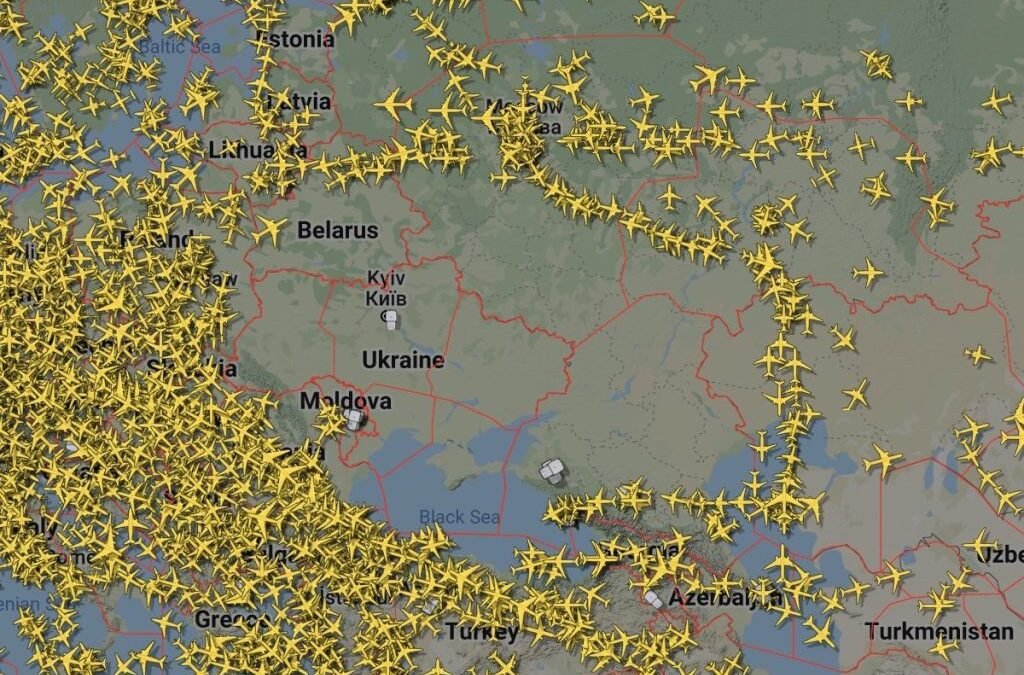
Executive Summary (9 August 2026): The Ukraine-Russia conflict remains the most severe aviation security crisis in Europe, now in its fifth year. Ukrainian airspace stays fully closed to all civil aviation, with zero permitted operations. EASA's Conflict Zone Information Bulletin for Ukraine (CZIB-2022-01) was revised on 24 July 2026, extending the avoidance guidance to at least 31 January 2027. Russia's missile and drone campaign intensified sharply through July 2026 — a wartime-record month for missile launches — with Ukrainian air defences reportedly stretched thin by interceptor shortages. GPS jamming and spoofing remain widespread across Eastern Europe and the Baltic states, with sustained interference reported as far as Finland and Sweden. Lviv International Airport is technically ready and Ukrainian officials have discussed a phased reopening, but no reopening date has been set — the airspace closure remains in force. Global rerouting is further complicated by the parallel Middle East airspace crisis, which is affecting many of the same long-haul corridors.
Current Threat Assessment – 9 August 2026
- Missile Threats: Russia fired a wartime-record number of missiles in July 2026, including a record monthly total of ballistic missiles; trajectories frequently cross international air corridors near Ukraine's borders.
- Drone Operations: Large-scale Shahed-type drone swarms continue on a near-nightly basis, creating significant collision and misidentification risk near border regions.
- Air Defence Saturation: Reports indicate Ukrainian air defences are intercepting the large majority of drones but a much smaller share of ballistic missiles amid interceptor supply constraints — increasing the risk of stray debris and unpredictable trajectories near controlled airspace.
- GPS/GNSS Interference: Widespread jamming and spoofing detected across Finland, Estonia, Latvia, Lithuania, Poland and Sweden, with some national authorities reporting interference rates many times higher than in 2024.
- Regional Escalation Events: Poland has scrambled fighter jets and Finland has imposed temporary aviation restriction zones over the Gulf of Finland in response to large Russian strikes on Ukraine.
- Air Defence & EW: Active long-range SAM systems and advanced electronic warfare continue to target aviation navigation and communication systems.
Current Airspace Status (9 August 2026)
No civil operations permitted since 24 February 2022. Military activity only. EASA CZIB-2022-01 (Revision 14, issued 24 July 2026) extends the avoidance guidance to at least 31 January 2027.
EASA-mandated avoidance. Enhanced ATC procedures required. Frequent GPS interference.
Closed to most Western operators. Limited approved traffic only.
Active naval warfare area. Recommended 200NM clearance from Crimean coast.
Finland introduced a temporary aviation restriction zone over the eastern Gulf of Finland in July 2026 following a large-scale Russian strike on Ukraine. Sustained GNSS jamming/spoofing reported across Finland, Estonia, Latvia, Lithuania and Poland.
🚨 Critical Safety Notice – 9 August 2026
All operators must continue to treat GNSS as unreliable within 500km of Ukrainian borders, and should expect intermittent interference across the wider Baltic region. Maintain proficiency in conventional/inertial navigation and enhanced visual lookout for drone traffic. Operators planning routings anywhere near Eastern Europe, the Black Sea or the Gulf of Finland should request an updated risk briefing before filing a flight plan — contact our 24/7 operations desk.
Timeline of Key Aviation Events
Ukrainian Airspace Closure: Complete shutdown of all Ukrainian FIRs.
Russian Airspace Restrictions & GPS Jamming Expansion: Widespread interference across Eastern Europe.
Reopening Planning: Ukraine forms a high-level working group to prepare Boryspil, Lviv and Kyiv (Zhuliany) airports for a potential phased reopening (planning stage only).
High-Profile GPS Jamming Incident: A UK military aircraft carrying the UK Defence Secretary reportedly experienced suspected GPS interference near Estonian airspace, requiring a switch to backup inertial navigation — illustrating the reach of Baltic jamming activity.
Major Strike & Regional Response: Russia launches a large-scale missile and drone strike on Ukraine; Poland scrambles fighter jets and Finland introduces a temporary aviation restriction zone over the Gulf of Finland.
EASA CZIB Extended: EASA issues Revision 14 of CZIB-2022-01, extending Ukrainian airspace avoidance guidance to at least 31 January 2027.
Lviv Reopening Signals: Lviv's mayor states the airport is technically undamaged and ready, and could reopen "within weeks" once security conditions allow. No official reopening date has been confirmed and Ukrainian airspace remains closed.
Record Strike Tempo: A large drone and ballistic missile barrage hits Kyiv, causing multiple fatalities, following a wartime-record month of missile launches in July.
No Reopening: Ukrainian airspace remains completely closed. Missile and drone campaign continues at elevated tempo. GPS/GNSS jamming remains persistent across the Baltics and Eastern Europe. Reopening planning for Lviv continues but remains contingent on the security situation.
Operational Recommendations
For Commercial Airlines
- Maintain minimum 100NM clearance from Ukrainian borders.
- Implement GPS interference mitigation procedures, including readiness to revert to inertial/conventional navigation.
- Monitor EASA CZIB, OPSGROUP and NOTAMs continuously — the Ukraine CZIB validity period has changed multiple times in 2026.
- Cross-check routing against parallel risk zones, including the West Asia airspace restrictions affecting many of the same long-haul corridors.
For Private & Business Aviation
- Absolute avoidance of Ukrainian and most Russian airspace.
- Minimum 200NM clearance from conflict zones; treat the Gulf of Finland and eastern Baltic as an elevated-risk area for GNSS reliability.
- Dual independent navigation systems mandatory.
- Verify war-risk insurance coverage before filing any routing near Eastern Europe or the Black Sea.
- For repositioning, evacuation or mission-specific charter near conflict-adjacent regions, speak to our special mission aircraft charter desk before planning a routing.
Frequently Asked Questions (Updated 9 August 2026)
Ukrainian airspace remains completely closed to all civil aviation since February 2022. EASA's Conflict Zone Information Bulletin (CZIB-2022-01) was revised on 24 July 2026 and now extends the avoidance guidance to at least 31 January 2027. A high-level working group formed in March 2026 continues planning a potential phased reopening starting with Lviv, but no reopening date has been confirmed.
Not yet, officially. Lviv International Airport is reported to be technically undamaged and ready to resume operations, and local officials have said it could reopen within weeks once security conditions allow, with several airlines reportedly prepared to launch service quickly. However, no official reopening date has been set, and Ukrainian airspace — including Lviv — remains closed under the current EASA CZIB.
Primary risks include cruise and ballistic missile trajectories, large-scale drone swarms, widespread GPS jamming/spoofing, potential misidentification by air defence systems, and cyber/electronic warfare threats. Missile and drone tempo has been at wartime-record levels through mid-2026, with reports of stretched Ukrainian air-defence interceptor supplies increasing the risk of unpredictable trajectories.
GPS/GNSS interference continues to be reported across Finland, Estonia, Latvia, Lithuania, Poland, Sweden, the Black Sea and parts of the Eastern Mediterranean. Some national authorities have reported interference incident rates many times higher than 2024 levels, and a high-profile UK military flight reported suspected jamming near Estonia in May 2026. The EU has announced sanctions targeting those responsible and is rolling out anti-spoofing authentication and monitoring services.
Extreme caution required. Minimum 200NM clearance from Ukrainian/Belarusian borders is strongly recommended, and operators should treat the Gulf of Finland/eastern Baltic as an elevated-risk area given ongoing GNSS interference. Only experienced crews with conflict-zone training and valid war-risk insurance should operate in the region. Speak to a specialist charter desk before filing any routing near the region.
There is no confirmed timeline. Reopening requires a sustained reduction in hostilities, demining, restoration of ATC infrastructure, insurer buy-in, and full ICAO/IATA sign-off. As of August 2026, planning has advanced furthest for Lviv, but the airspace closure remains fully in force and could persist well beyond the current EASA CZIB validity date of 31 January 2027.