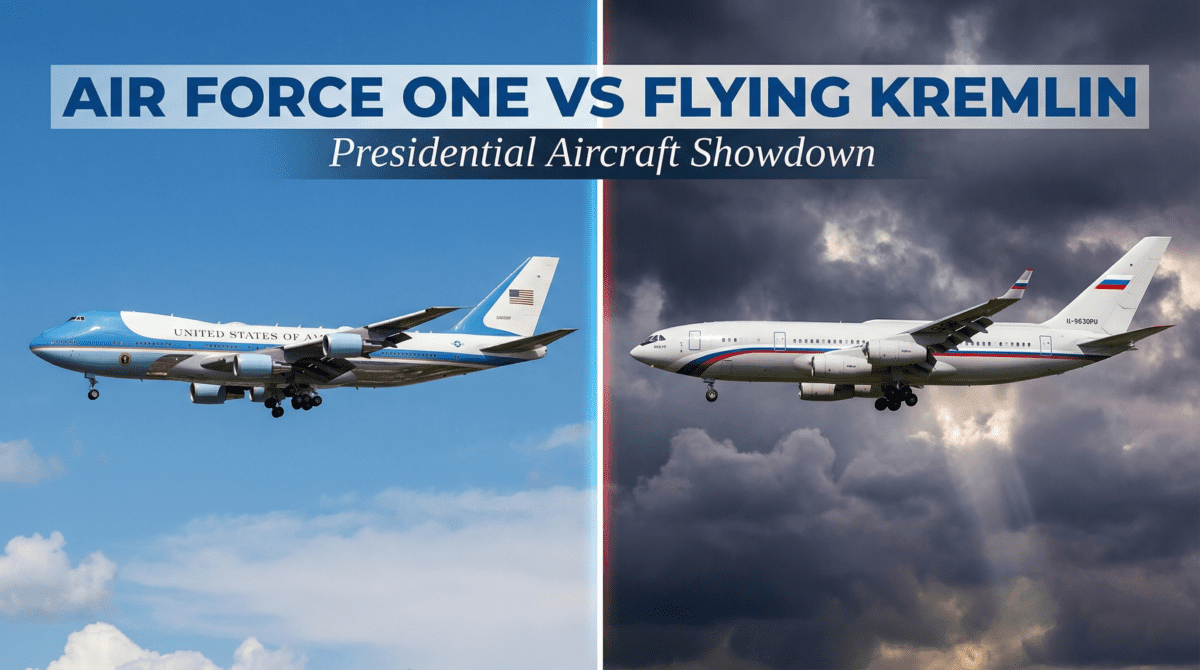
Presidential Aircraft Showdown: Air Force One vs Russias Flying Kremlin – Complete Comparison 2026
Presidential Aircraft Showdown: Air Force One vs. Russia's Flying Kremlin
A Comprehensive Comparison of the World's Most Famous Presidential Aircraft
When world leaders take to the skies, they do so in flying fortresses that represent the pinnacle of aviation technology, luxury, and security. The United States' iconic Air Force One and Russia's formidable Ilyushin Il-96-300PU (dubbed the "Flying Kremlin") stand as symbols of national power and prestige. But how do these two legendary presidential aircraft actually compare? In this comprehensive analysis, we'll explore every aspect of these airborne command centers, from their technical specifications to their operational costs, security features, and the unique capabilities that set them apart.

The Icons: Meet the Aircraft
Air Force One: America's Flying Oval Office
The term "Air Force One" refers to any United States Air Force aircraft carrying the President, but it's primarily associated with two highly customized Boeing VC-25A aircraft based on the Boeing 747-200B platform. These aircraft have served as the primary presidential transport since 1990, replacing the older Boeing 707-based VC-137s.
The current Air Force One fleet consists of two identical aircraft:
- Tail Number 28000 (delivered in 1990)
- Tail Number 29000 (delivered in 1991)
These aren't just planes—they're mobile command centers capable of functioning as the nerve center of the United States government, even during a national crisis. Source: U.S. Air Force
Ilyushin Il-96-300PU: Russia's Flying Kremlin
Russia's presidential aircraft represents a different philosophy—a fully domestically-produced platform showcasing Russian engineering prowess. The Ilyushin Il-96-300PU has been the primary presidential aircraft since 1996, serving both Boris Yeltsin and Vladimir Putin.
The "PU" designation stands for "Punkt Upravleniya" (Command Point), emphasizing its role as an airborne command center. Russia actually operates five modified Il-96s in the presidential fleet, providing redundancy and flexibility for diplomatic missions. Source: Safe Fly Aviation
Technical Specifications: By the Numbers
Size and Dimensions Comparison
| Specification | Air Force One (VC-25A) | Il-96-300PU |
|---|---|---|
| Base Aircraft | Boeing 747-200B | Ilyushin Il-96-300 |
| Length | 231 feet 10 inches (70.7 m) | 181 feet 7 inches (55.35 m) |
| Wingspan | 195 feet 8 inches (59.6 m) | 197 feet 3 inches (60.12 m) |
| Height | 63 feet 5 inches (19.3 m) | 51 feet 5 inches (15.7 m) |
| Number of Engines | 4 turbofans | 4 turbofans |
| Engine Type | GE CF6-80C2B1 | Aviadvigatel PS-90A |
| Thrust per Engine | 56,700 pounds | 35,242 pounds |
The American aircraft is significantly longer and taller, reflecting its Boeing 747 heritage as one of aviation's most iconic wide-body jets. However, the Russian aircraft actually has a slightly wider wingspan by about 1.5 feet. Source: AeroTime
Performance Capabilities
| Performance Metric | Air Force One | Il-96-300PU |
|---|---|---|
| Maximum Range | 7,800 miles (12,600 km) | ~8,000 miles (13,000 km) |
| Cruising Speed | 630 mph (Mach 0.84) | 528-541 mph (Mach 0.78-0.84) |
| Maximum Altitude | 45,100 feet | 43,000 feet |
| Passenger Capacity | 76 passengers + 26 crew | 262 passengers (standard config) |
| Fuel Capacity | Not publicly disclosed | 152,620 liters |
Key Capability: Both aircraft feature aerial refueling capabilities, allowing them to remain airborne indefinitely—a critical feature for ensuring continuity of government during crises. Source: The White House
Interior Design: Where East Meets West
Air Force One Interior: Functional Elegance
The interior of Air Force One spans approximately 4,000 square feet across three levels, divided into several distinct areas:
- Presidential Suite: Located at the nose of the aircraft, featuring:
- A private office with the presidential seal
- A conference room for secure meetings
- A private bedroom
- A bathroom with shower facilities
- Medical Suite: A fully equipped medical facility that can function as an operating room, with a doctor permanently on board
- Conference/Situation Room: Secure facilities for classified briefings and crisis management
- Communications Center: State-of-the-art equipment allowing secure contact with anyone, anywhere in the world
- Staff Areas: Separate sections for senior staff, Secret Service, security personnel, and guests
- Galleys: Two food preparation areas capable of serving 100 people
- Press Area: Seating for journalists at the rear of the aircraft
The design philosophy emphasizes functionality over opulence, with a restrained aesthetic befitting the seriousness of the office. Source: Boeing
Il-96-300PU Interior: Flying Palace
In stark contrast, the Russian presidential aircraft features what many describe as a "flying palace" aesthetic:
- Gold-Plated Fixtures: Unlike the more subdued American interiors, the Il-96-300PU features gold-plated bathrooms and fittings
- Presidential Suite: Includes private quarters with luxurious furnishings reflecting traditional Russian grandeur
- Conference Rooms: Multiple meeting spaces designed to resemble Kremlin interiors
- Private Gym: Dedicated fitness facilities for the president
- Secure Communication Systems: Advanced encrypted communications allowing command and control functions
The interior design reflects Russia's desire to project prestige and luxury, creating what essentially amounts to a mobile Kremlin residence in the sky. Source: WION News
Security Features: Flying Fortresses
Air Force One Security Systems
Air Force One is arguably the most secure aircraft on the planet, equipped with:
1. Electronic Countermeasures (ECM)
- Radar-jamming technology
- Infrared countermeasures to deflect heat-seeking missiles
- Chaff and flare dispensers
2. Electromagnetic Pulse (EMP) Protection
All onboard electronics are hardened against electromagnetic pulses, including those from nuclear detonations
3. Secure Communications
- Multi-frequency radios for air-to-air, air-to-ground, and satellite communications
- Encrypted communication systems allowing classified conversations
- Ability to function as a mobile command center with nuclear launch capabilities
4. Armor and Structural Protection
- Reinforced hull
- Armored cockpit doors
- Bulletproof windows in certain areas
5. Self-Sufficiency
- Aerial refueling capability for indefinite flight time
- Onboard oxygen generation systems
- Advanced environmental controls
The exact nature of many security features remains classified, but Air Force One is designed to survive and operate through virtually any threat scenario. Source: USAMM
Il-96-300PU Security Features
Russia's presidential aircraft incorporates its own formidable security measures:
1. Countermeasures Systems
- Anti-missile defense systems
- Radar-jamming technology
- Missile warning systems
2. Secure Communications
- Encrypted satellite communications
- Direct links to Russian military command structure
- Nuclear command and control capabilities
3. Electronic Protection
- Electromagnetic attack protection
- Advanced avionics designed to resist electronic warfare
4. Operational Security
- Often flies with escort aircraft
- Unpredictable flight patterns and schedules
- Multiple identical aircraft for operational security
While specific details remain classified, the Il-96-300PU is designed to serve as Russia's airborne command post in times of crisis. Source: NDTV
Cost Analysis: Operating Expenses
Air Force One Operating Costs
Operating Air Force One is extraordinarily expensive:
Cost Breakdown Includes:
- Fuel costs
- Maintenance and repairs
- Engineering support
- Crew salaries and training
- Food and lodging for crew
- Communications equipment operation
- Security personnel expenses
The high operational cost reflects not just the aircraft itself but the entire support infrastructure, including advance teams, security arrangements, and backup aircraft. Source: The War Zone
Il-96-300PU Operating Costs
While Russia doesn't publicly disclose operational costs, estimates suggest:
- Estimated Aircraft Cost: Around $60 million for the basic Il-96-300PU platform
- Operating Costs: Significantly lower than Air Force One due to:
- Smaller aircraft size
- Less powerful engines (lower fuel consumption)
- Different maintenance standards
- Lower crew costs
The Russian aircraft operates at a fraction of the cost of its American counterpart, though this partly reflects different operational philosophies and reporting standards. Source: Air Charter Service
Crew and Personnel
Air Force One Crew Complement
The VC-25A requires a substantial crew:
Flight Crew: 26 Personnel
- Pilot and co-pilot
- Flight engineer
- Navigator
- Additional cockpit crew
Additional Personnel:
- Cabin Crew: Multiple flight attendants trained to military standards
- Communications Specialists: Operating advanced secure communication systems
- Maintenance Personnel: Onboard technicians for in-flight repairs
- Security Team: Secret Service agents providing close protection
- Medical Staff: A doctor is permanently assigned to accompany the president
Total Capacity: Can accommodate up to 102 people (76 passengers + 26 crew)
Il-96-300PU Crew
The Russian aircraft operates with a similar crew structure:
- Flight Crew: Trained military pilots and navigators
- Security Personnel: FSO (Federal Protective Service) agents
- Support Staff: Communications, medical, and service personnel
- Standard Capacity: Configured for presidential needs rather than maximum passenger count
Technological Capabilities
Advanced Communication Systems
| Feature | Air Force One | Il-96-300PU |
|---|---|---|
| Telephone Systems | 85 telephones throughout aircraft | Multiple secure lines |
| Satellite Communications | Multi-frequency satellite systems | Encrypted satellite communications |
| Video Conferencing | Secure video conferencing capabilities | Advanced conferencing systems |
| Military Links | Direct links to U.S. military command | Direct links to Russian military HQ |
| Nuclear Command | Nuclear forces coordination capability | Nuclear command capabilities |
| Internet Access | Connectivity for staff and press | Secure government network access |
Avionics and Navigation
Air Force One:
- State-of-the-art navigation systems
- Advanced weather radar
- Terrain-following systems
- Multiple redundant navigation systems
- Glass cockpit with modern displays
Il-96-300PU:
- Modern Russian avionics suite
- Six multi-function color LCD displays
- Inertial and satellite navigation systems
- Fly-by-wire flight controls
- Advanced autopilot systems
Source: Wikipedia - Ilyushin Il-96
Historical Context and Service Record
Air Force One Evolution
The current VC-25A aircraft have served since 1990, carrying six U.S. presidents:
- George H.W. Bush (1989-1993)
- Bill Clinton (1993-2001)
- George W. Bush (2001-2009)
- Barack Obama (2009-2017)
- Donald Trump (2017-2021)
- Joe Biden (2021-present)
These aircraft have witnessed countless historic moments, from presidential summits to crisis management during 9/11, when President Bush directed the response from aboard Air Force One.
Il-96-300PU Service
The Russian presidential fleet has served since 1996:
- Boris Yeltsin (first user)
- Vladimir Putin (2000-2008, 2012-present)
- Dmitry Medvedev (2008-2012)
The aircraft has been used for numerous international summits, state visits, and diplomatic missions, serving as a symbol of Russian power projection.
The Future: Next Generation Presidential Aircraft
VC-25B: The Next Air Force One
The United States is replacing its aging VC-25A fleet with new Boeing 747-8 based aircraft designated VC-25B:
Key Features:
- Based on the more modern Boeing 747-8 platform
- Enhanced fuel efficiency
- State-of-the-art communication systems
- Improved security features
- Approximately 4,000 square feet of interior space across three levels
- Advanced defensive systems
Timeline:
- Expected Delivery: 2027 for the first aircraft, 2028 for the second
- Original Budget: The program has faced significant delays and cost overruns
- Modifications: Extensive customization to meet presidential requirements
The new aircraft will serve presidents well into the 2050s or beyond. Source: Simple Flying
Russia's Future Plans
Russia continues to operate its Il-96-300PU fleet and has reportedly considered:
- Further modifications to existing aircraft
- Potential development of new presidential aircraft based on updated platforms
- Continued use of multiple identical aircraft for operational security
Key Differences Summary
Size Winner
Air Force One
231 ft vs 181 ft length
Cost Efficiency
Il-96-300PU
Significantly lower operating costs
Luxury Interior
Il-96-300PU
Gold-plated fixtures and opulence
Global Recognition
Air Force One
Iconic worldwide symbol
Where Air Force One Excels
- Size and Presence: Significantly larger aircraft with greater imposing presence
- Range and Endurance: Slightly better unrefueled range capabilities
- Medical Facilities: More extensive onboard medical suite
- International Recognition: Iconic status as symbol of American presidency
- Technology Integration: Latest Western communication and avionics systems
Where Il-96-300PU Stands Out
- Cost Efficiency: Lower operating costs and acquisition price
- Domestic Production: Fully Russian-designed and manufactured
- Luxury Interior: More opulent cabin design with gold fixtures
- Fleet Redundancy: Multiple identical aircraft for security
- Modern Platform: Technically newer airframe design (1992 vs. 1969)
Cultural and Symbolic Significance
Air Force One as American Icon
Air Force One has transcended its role as mere transportation to become:
- A symbol of American democracy and presidential power
- An instantly recognizable icon of U.S. foreign policy
- A subject of films, documentaries, and popular culture
- A representation of American technological prowess
- A mobile representation of the Oval Office
The distinctive blue and white livery, designed during the Kennedy administration, is known worldwide and immediately signals presidential presence.
The Flying Kremlin as Russian Pride
The Il-96-300PU represents:
- Russian engineering independence and capability
- Continuation of Soviet aviation traditions
- National prestige in aircraft manufacturing
- Russia's position as a major world power
- An alternative to Western aviation dominance
The aircraft showcases Russia's determination to maintain indigenous capabilities across strategic industries.
Interesting Facts and Trivia
Air Force One Facts
- Any Aircraft Can Be Air Force One: The call sign applies to any USAF aircraft carrying the president—even a helicopter becomes "Marine One"
- Presidential Escape Pod Myth: Contrary to popular belief, Air Force One does NOT have an escape pod
- Food Storage: Can store enough food to feed passengers for weeks
- In-Flight Refueling: Can refuel mid-air to stay airborne indefinitely
- Presidential Seal: Features the presidential seal on the exterior and throughout the interior
- Cost Per Minute: At $177,843 per hour, Air Force One costs approximately $2,964 per minute to operate
Il-96-300PU Facts
- Multiple Decoys: Russia operates several identical aircraft to confuse potential threats
- Domestic Pride: One of the few large commercial aircraft still in production in Russia
- VIP Variants: Besides presidential use, Il-96s serve other Russian VIPs and government officials
- Gold Standard: The liberal use of gold fixtures has led to its "Flying Kremlin" nickname
- International Diplomacy: Has been used for major international summits and state visits worldwide
Conclusion: Two Philosophies, One Purpose
The comparison between Air Force One and Russia's Il-96-300PU "Flying Kremlin" reveals much more than just technical specifications—it illuminates two different approaches to presidential air transport that reflect broader national philosophies.
Air Force One represents the American approach: maximize capability, project transparency, leverage advanced technology, and create an instantly recognizable global icon. It's bigger, more expensive, and carries the weight of being perhaps the most famous aircraft in the world. The upcoming VC-25B will continue this tradition with enhanced capabilities.
The Il-96-300PU embodies Russian priorities: maintain independence through domestic production, project prestige through luxury, ensure flexibility with multiple aircraft, and balance capability with cost-effectiveness. It may not have Air Force One's global recognition, but it effectively serves Russian presidential needs.
Both aircraft excel at their primary mission: protecting their nations' leaders while providing mobile command centers capable of managing global crises. Whether you prefer the functional American approach or the luxurious Russian style, both represent remarkable achievements in aviation engineering and national capability.
As we look to the future, both nations continue investing in presidential air transport, recognizing that in our interconnected world, the ability to project power and leadership from the skies remains as important as ever. The new VC-25B scheduled for delivery in 2027 will ensure American presidents have cutting-edge capabilities for decades to come, while Russia continues upgrading its Il-96 fleet to meet evolving requirements.
In the end, these aren't just aircraft—they're flying embassies, mobile command centers, and powerful symbols of national sovereignty and presidential authority. Whether painted in American blue and white or featuring Russian gold-plated luxury, both serve as reminders that when world leaders travel, they carry their nations' power and prestige with them into the skies.
Frequently Asked Questions (FAQ)
Related Topics and Keywords
Keywords: Air Force One, Russian Presidential Aircraft, Il-96-300PU, Flying Kremlin, Presidential Aviation, VC-25A, VC-25B, Boeing 747, Ilyushin Il-96, Presidential Security, Government Aircraft, Military Transport, Presidential Travel, Aviation Comparison, Presidential Fleet, Executive Airlift, Safe Fly Aviation, Presidential Plane Comparison, Air Force One vs Putin's Plane, Presidential Jets, Government Aviation, VIP Aircraft, Head of State Transport, Command Aircraft