The Billion-Dollar Question: Have Sanctions Actually Weakened Russian Aviation | Safe Fly Aviation
The Billion-Dollar Question: Have Sanctions Actually Weakened Russian Aviation?
A balanced, data-driven assessment of fleet stability, cost inflation, safety erosion, and production failures
 Russian Aviation Under Sanctions — The Billion-Dollar Question
Four years after Western sanctions targeted Russia's aviation sector, the answer to the billion-dollar question is neither simple nor binary. Russia's commercial fleet has not collapsed. Domestic air capacity hovers near pre-war levels. Aeroflot posted record revenues in 2025. On paper, Russian aviation appears resilient.
But beneath the surface, the costs are staggering. Maintenance expenses have surged. Safety margins have eroded. The manufacturing renaissance promised by the MC-21 and SJ-100 programs remains years behind schedule. Western lessors and insurers have written off billions. Russian aviation survives—but at what cost?
This report provides a balanced, data-driven assessment of the real impact of sanctions on Russian aviation, examining hard metrics, qualitative costs, and the long-term trajectory of the sector.
The Metrics: What the Numbers Tell Us
The headline numbers present a picture of remarkable stability:
Russia's passenger fleet dropped from approximately 800 pre-war aircraft to around 838 in 2026, with Western-built aircraft declining from ~560 to 460. The fleet has stabilized through re-registration, aggressive cannibalization, and the emergence of gray-market parts networks.
Russian Fleet Composition (2022 vs. 2026)
Source: Rosaviatsia, industry data
Aeroflot's operational metrics remain surprisingly robust. The airline reported record revenues in 2025, driven by strong domestic demand and the absence of competition on many routes. However, this apparent success masks the underlying fragility of the sector.
The Costs: What the Metrics Don't Show
The true cost of sanctions is evident in areas that do not appear in revenue statements or fleet counts.
Maintenance Cost Inflation
Aeroflot's maintenance expenses rose 19% in 2025 compared to the previous year. This is not a one-year anomaly; it reflects the structural cost of maintaining Western-built aircraft without access to OEM parts or certified supply chains.
Key Cost Increases (2024–2026)
Source: Aeroflot reports, industry data
The gray-market markup is particularly stark. Engines purchased in the West for approximately $17 million are being resold through Indian intermediaries for $24 million — a 41% premium. These costs are ultimately passed to passengers through higher fares or absorbed by state subsidies.
Billion-Dollar Losses
- Western lessor write-offs: Over $10 billion in stranded aircraft assets
- Insurer claims: Exceeding $8 billion from repossessed and stranded aircraft
- Insurance premiums: Tripled for Russian-related aviation exposure
- Government subsidies: Billions in state support to keep airlines operational
Western Lessor and Insurer Losses
The financial impact on Western aviation companies has been severe. Major lessors including AerCap, SMBC Aviation Capital, and BOC Aviation have written off billions in assets. Insurers face claims exceeding $8 billion, and premiums for Russian-related exposures have tripled.
Several lessors have abandoned Russia entirely, while others continue to pursue legal claims through international courts. The recovery of aircraft and assets remains uncertain, with most industry observers expecting minimal returns.
Safety Erosion: The Invisible Cost
Perhaps the most concerning impact of sanctions is the degradation of safety standards. While a catastrophic incident has not yet occurred, the data points to a system under strain.
Safety Indicators (2022–2026)
Source: Aviation Safety Network, industry reports
The EASA blacklisting of Russian airlines and the FAA downgrade of Russia's safety oversight rating are not bureaucratic formalities. They reflect a genuine deterioration in maintenance standards and regulatory oversight.
Reports of Aeroflot operating aircraft with disabled brakes (relying on reverse thrust) and instructions to flight attendants not to log certain defects are symptomatic of a system that prioritises operational continuity over compliance.
Production Failures: The Manufacturing Mirage
Russia's aviation manufacturing sector was supposed to replace Western imports. It has not.
Production Targets vs. Reality (2023–2026)
Source: UAC, industry reports
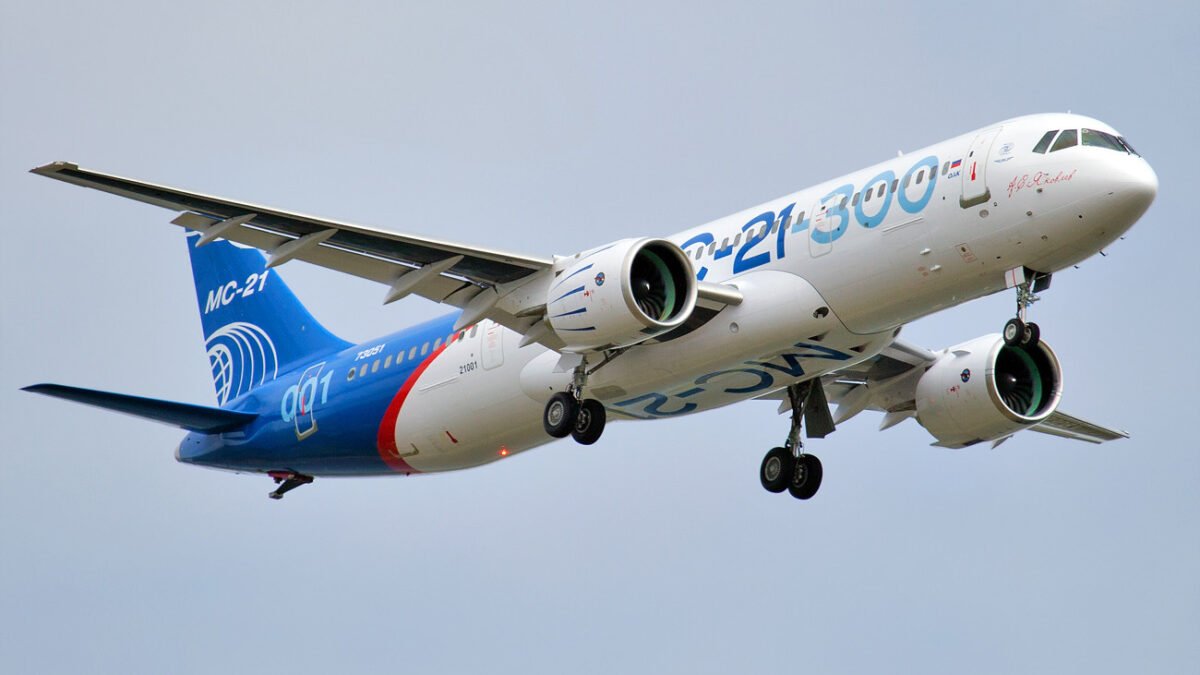
The MC-21-310 variant with the domestic PD-14 engine achieved its first flight in late 2025. Certification is targeted for end-2026, with serial production realistically slipping to 2027 or later. Key foreign-sourced items—ice protection, vacuum toilets, TCAS, weather radar, power supply—remain unresolved.
The SJ-100 (import-free Superjet) has faced similar challenges. Many airframes remain incomplete due to ongoing component shortages. The Sino-Russian CR929 widebody program has effectively ended for Russia.
Industry Challenges
- Machine tool shortages: UAC needed hundreds of additional units by 2026
- Personnel crisis: Over 14,000 vacancies industry-wide
- Missed targets: Production plans for 2023–2025 slashed to a fraction
- Timeline: One Russian minister suggested 20+ years to build a fully indigenous industry from scratch
Route Network: Before and After
The closure of Western airspace has fundamentally changed Russia's international connectivity.

Before the invasion, Aeroflot and other Russian carriers operated extensive networks across Europe, North America, and Asia. Today, Russian airlines are confined to a handful of friendly nations: China, India, Turkey, the UAE, and Central Asian states. This has fundamentally altered Russia's economic and diplomatic connectivity.
Balanced Assessment: Has It Worked?
The question of whether sanctions have weakened Russian aviation requires a balanced answer.
On the one hand:
- Russia's passenger fleet has not collapsed
- Domestic capacity remains near pre-war levels
- Aeroflot posted record revenues in 2025
- Gray-market parts networks and domestic MRO have kept the fleet flying
- State subsidies have stabilised the sector
On the other hand:
- Maintenance costs have surged 19% in one year
- Safety margins have eroded significantly
- Manufacturing targets have been repeatedly missed
- International connectivity is a fraction of what it was
- Western lessors and insurers have lost over $18 billion combined
- Insurance premiums have tripled
- No sustainable path to fleet renewal without sanctions relief
The comparison to Iran is instructive. After decades of sanctions, Iran's aviation sector operates a fleet of aging aircraft held together by ingenuity, smuggling, and cannibalization. Safety incidents are frequent. International connectivity is limited. Russia appears to be following a similar trajectory.
Aviation Intelligence & Advisory
Need insight into sanctions impact, aircraft values, fleet strategy, or emerging market opportunities?
Speak with Our Aviation Intelligence TeamSources & References
- Rosaviatsia — Russian Fleet Registry Data (2026)
- Aeroflot — Financial and Operational Reports (2023–2025)
- Bloomberg — Russian Aviation Sanctions Coverage (2022–2026)
- Reuters — Russia Aircraft Leasing Crisis (2022–2025)
- Aviation Week — Russian Fleet Status Reports (2023–2026)
- EASA — Airworthiness Directives and Blacklisting (2022–2025)
- FAA — International Aviation Safety Assessments (2022–2025)
- S7 Technics — MRO Expansion Announcements (2025)
- UAC — MC-21 and SJ-100 Program Updates (2024–2026)
- Aviation Safety Network — Incident Database (2022–2026)
- Safe Fly Aviation — Market Intelligence Database (2026)
Disclaimer: This report is based on public sources and industry data as of June 2026. Information is for informational and educational purposes only. Safe Fly Aviation provides independent aviation intelligence and advisory services.
Frequently Asked Questions
How has Russia's fleet size changed since 2022?
Russia's passenger fleet dropped from approximately 800 pre-war aircraft to around 838 in 2026, with Western-built aircraft declining from ~560 to 460. The fleet has stabilized through re-registration, cannibalization, and gray-market parts.
What are the financial costs of sanctions on Russian aviation?
Aeroflot's maintenance costs rose 19% in one year. Engines purchased for $17M are being resold for $24M via gray-market routes. The sector relies on billions in government subsidies to remain operational.
How much have Western lessors and insurers lost?
Western lessors have written off over $10 billion in assets. Insurers face claims exceeding $8 billion from repossessed and stranded aircraft. Insurance premiums for Russian exposure have tripled.
Is Russian aviation safe under sanctions?
Safety has degraded. Malfunctions and emergency landings have increased. EASA blacklisted Russian airlines and the FAA downgraded Russia's safety rating. A320neo utilization is very low, with many grounded.
Has domestic production replaced Western aircraft in Russia?
No. The MC-21 and SJ-100 programs remain severely delayed. Certification for the MC-21 is targeted for end-2026, with serial production slipping to 2027 or later. Production targets have been repeatedly missed.
Safe Fly Aviation Intelligence Desk
The Safe Fly Aviation Intelligence Desk provides data-driven analysis of global aviation markets, geopolitical impacts, fleet economics, and emerging opportunities. Our reports support airlines, lessors, MROs, and investors in navigating complex aviation environments.
Editor: Director – Aviation Intelligence • Last Updated: 24 June 2026
© 2026 Safe Fly Aviation • Global Network: Dubai • London • New Delhi • Singapore