How to Transport Formula 1, 2 & 3 Cars via Cargo Charter Planes
How to Transport Formula 1, 2 & 3 Cars by Cargo Charter Plane: The Complete 2026 Guide
Every flyaway race weekend, disassembled race cars, garage equipment, tyres, and hospitality infrastructure are packed, customs-cleared, and flown across continents in under a week. Here's exactly how that logistics operation works — and what it costs.

Formula 1, Formula 2, and Formula 3 run truly global calendars, with races scheduled on consecutive weekends across different continents. Moving a race team — cars, spare parts, tyres, fuel-system equipment, and garage infrastructure — between venues thousands of miles apart, often with only days to spare, is one of motorsport's least visible but most demanding logistics operations. For European rounds, road transport is fast enough. For intercontinental "flyaway" races, teams depend on chartered cargo aircraft, and the entire operation runs on a tight, repeatable playbook of disassembly, packing, customs clearance, and precision-timed freighter flights.
This guide walks through that playbook: the aircraft involved, how many are chartered per event, what it costs, and the customs documentation — CPD Carnets and ATA Carnets — that keeps high-value racing equipment moving legally across more than a dozen countries each season.
The Global Racing Calendar
The scale of the logistics challenge starts with the calendar. All three FIA single-seater championships run condensed, globe-spanning seasons, and F2 and F3 largely share race weekends with F1, which is part of why their freight is often consolidated into the same charters.
| Series | 2026 Season | Typical Locations |
|---|---|---|
| Formula 1 | 24 Grands Prix | Europe, Asia, Americas, Middle East, Australia |
| Formula 2 | 14 rounds / 28 races | Shares most F1 weekends, 13 countries |
| Formula 3 | 10 rounds / 20 races | Mostly Europe, sharing selected F1 weekends |

Each race requires teams to move cars, spare parts, tyres, fuel, and garage equipment over distances that can span two continents in a single week. For the roughly two-thirds of the F1 calendar classified as flyaway events, road transport simply isn't fast enough — which is where cargo charter aviation comes in.
Why Air Freight Is the Preferred Choice
| Transport Mode | Advantages | Drawbacks |
|---|---|---|
| Sea Freight | Cost-effective for heavy loads | Takes weeks — too slow between consecutive race weekends |
| Road Transport | Efficient and economical for regional races | Limited to races within the same continent |
| Air Freight | Fastest option; direct routes; days instead of weeks | Highest cost, offset by the reliability it guarantees |
For European rounds, teams typically move equipment by road in a convoy of trucks. For intercontinental flyaway races — Australia, the Americas, and other overseas events — only air freight can realistically bridge the gap between a Sunday race finish and a garage that needs to be fully built by the following week.
The Transportation Process, Step by Step
Disassembly
Teams remove the front and rear wings, mirrors, suspension components, gearbox, and engine, reducing each car to a compact set of parts that fit standard cargo containers. A 2026-specification F1 car is commonly estimated at $15–22 million to build, though neither the FIA nor any team publishes an official per-car figure — the cost cap regulates total season spending, not individual chassis cost.
Packing and crating
Components go into custom foam-slotted boxes and shock-protected crates; the chassis is encased in a purpose-built cover sized to the aircraft's cargo hold. Temperature-sensitive components travel in climate-controlled containers, and shipments increasingly carry real-time location and condition tracking.
Loading, in priority order
Containers are sequenced for loading based on what's needed first at the destination — garage panelling and IT infrastructure typically go in last so they can be unloaded first, letting the crew start building the garage immediately on arrival.
Flight and unloading
Freighters fly direct routes where possible — Europe to Australia in a matter of hours rather than the weeks sea freight would take — and are unloaded at the destination airport using cranes and specialised ground equipment before the final road transfer to the circuit.
Aircraft Used and How Many Are Chartered
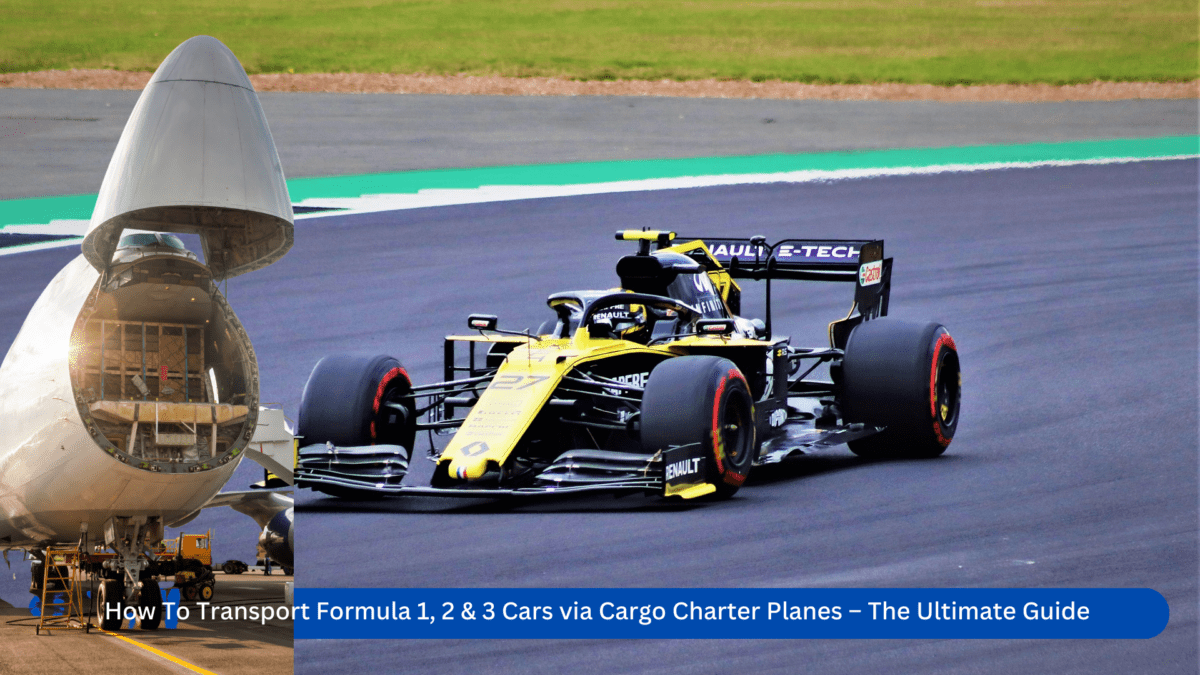
The Boeing 747 freighter is the workhorse of Formula 1's cargo operation, chosen for its nose-loading door, which accommodates oversized components like a race car chassis that wouldn't fit through a standard side cargo door on smaller freighters. DHL, working in partnership with Formula One Management, typically charters six to seven Boeing 747 freighters per flyaway event to move the full scale of team equipment — cars, tyres, garage infrastructure, and hospitality units — between hub airports and race venues.
F2 and F3 cars and equipment — lower in value and volume than F1's, but still high-performance, high-value assets — are typically consolidated into the same DHL/FOM charter network when they share a race weekend with F1, reducing cost and logistical complexity for the smaller series.
Customs Documentation: CPD Carnet vs. ATA Carnet
International motorsport freight depends on getting customs paperwork right at every border, and the two carnet systems involved are often confused with each other — understandably, since both function as a "passport for goods." They cover different things.
The key distinction: a CPD Carnet (Carnet de Passages en Douane) is the document that covers the vehicles themselves — the race cars — for temporary import without paying duty, provided they're re-exported within the agreed period. An ATA Carnet covers professional equipment, tools, spares, and other goods, but by its own governing convention explicitly excludes motor vehicles, which are handled separately under the CPD system. A team's cars and its garage equipment typically travel under two different carnets, not one.
| Document | Covers | Purpose |
|---|---|---|
| CPD Carnet | The race cars themselves | Temporary vehicle import without customs duty |
| ATA Carnet | Tools, spares, professional equipment | Temporary import of non-vehicle goods, valid in 100+ countries |
| Bill of Lading | The freight shipment | Receipt and contract used for customs clearance |
| Commercial Invoice | Transaction value of goods | Required for import/export compliance |
| Packing List | Full shipment inventory | Verification on arrival |
Some destinations also require FIA event documentation confirming a car's use in an official competition, plus country-specific import permits. Because F2 and F3 typically share venues and logistics providers with F1, the same document set applies across all three series.
Cost Factors in Motorsport Air Transport
Air freight costs for a single race are commonly estimated in the range of several hundred thousand dollars, driven by distance and destination, aircraft type, fuel prices and taxes, and airport handling fees. Freight costs across the sport have also been rising: container shipping rates used in F1 logistics climbed from roughly $1,733 in January 2020 to $9,420 in January 2022, and trucking costs have followed a similar upward trend — pressure that shows up directly in team logistics budgets, which sit inside the sport's overall $300–400 million annual team cost cap.
Teams manage this cost with carnets that avoid duty payments, careful load consolidation across shared F1/F2/F3 charters, and long-term contracts with logistics partners like DHL. Timely arrival is treated as non-negotiable — a missed freighter slot can mean a team arrives without a fully built garage, so reliability is weighted more heavily than finding the cheapest possible routing.
Challenges and How Teams Manage Them
- Weather disruption. Fog, storms, or other conditions at origin or destination airports can delay freighter departures, which is why teams build buffer time into their shipping schedules rather than working to the tightest possible connection.
- Aircraft or routing issues. Mechanical delays or route changes are mitigated with contingency plans, including backup flights and expedited handling agreements with charter partners.
- Customs delays. Incomplete or mismatched carnet paperwork is one of the most common causes of border hold-ups — getting the CPD/ATA Carnet distinction right, and keeping documentation consistent across a shared F1/F2/F3 shipment, avoids most of these.
- Real-time visibility. Tracking systems that monitor location and handling conditions let logistics teams respond quickly if a shipment falls behind schedule, across all three series.

Sources and Data
- RacingNews365 – 2026 Formula 1 calendar, 24 Grands Prix
- FIA Formula 2 Championship – official 2026 season calendar, 14 rounds / 28 races
- FIA Formula 3 Championship – official 2026 season calendar, 10 rounds / 20 races
- GP Destinations – Formula 1 logistics, DHL Boeing 747 charter figures
- F1 Chronicle – 2026-specification Formula 1 car build cost estimates
- PlanetF1 – Formula 1 logistics and shipping cost trends
- Wikipedia – ATA Carnet and Carnet de Passages en Douane (CPD)
Related resources
Frequently Asked Questions
How many cargo planes does Formula 1 charter per race?
DHL, working with Formula One Management, typically charters six to seven Boeing 747 freighters for each flyaway (intercontinental) race weekend, carrying team cars, garage equipment, tyres, and hospitality infrastructure. European races that don't require air freight are moved by road instead.
What's the difference between a CPD Carnet and an ATA Carnet for racing cars?
A CPD Carnet (Carnet de Passages en Douane) is the customs document used to temporarily import the vehicles themselves — the race cars — without paying import duty, provided they're re-exported within the agreed period. An ATA Carnet covers professional equipment, tools, spares, and other goods, but explicitly excludes motor vehicles, which are handled separately under the CPD system.
How much does a Formula 1 car cost to build?
Neither the FIA nor any team publishes an official build cost, since the FIA's cost cap regulates a team's total annual spending rather than any single chassis. Industry estimates for a 2026-specification car commonly range from $15 million to $22 million, with the power unit alone estimated at $8-11 million.
Why can't Formula 1 cars travel by sea freight?
Sea freight is cheaper for heavy loads but takes weeks, while the F1, F2, and F3 calendars often schedule races on consecutive weekends across different continents. Air freight is the only option fast enough to move disassembled cars and equipment between venues within the days available.
How many races are in the 2026 Formula 1, F2, and F3 seasons?
The 2026 FIA Formula 1 World Championship calendar features 24 Grands Prix. Formula 2 runs 14 rounds for 28 races across 13 countries, and Formula 3 runs 10 rounds for 20 races, with F2 and F3 largely sharing race weekends with F1.
Can Safe Fly Aviation arrange cargo charters for motorsport equipment?
Yes. Safe Fly Aviation arranges cargo and freighter charters worldwide for time-sensitive, high-value freight, including motorsport equipment, and can advise on customs documentation such as CPD and ATA Carnets for cross-border race logistics.
Need a cargo charter for time-sensitive, high-value freight?
Safe Fly Aviation arranges cargo and freighter charters worldwide, including motorsport, exhibition, and other high-value equipment moves, with support for CPD and ATA Carnet documentation.
Get a cargo charter quote