Modern Aircraft Hydraulic Systems 2026 | Architecture, MRO & Reliability
Modern Aircraft Hydraulic Systems
Architecture, MRO & Reliability Guide 2026

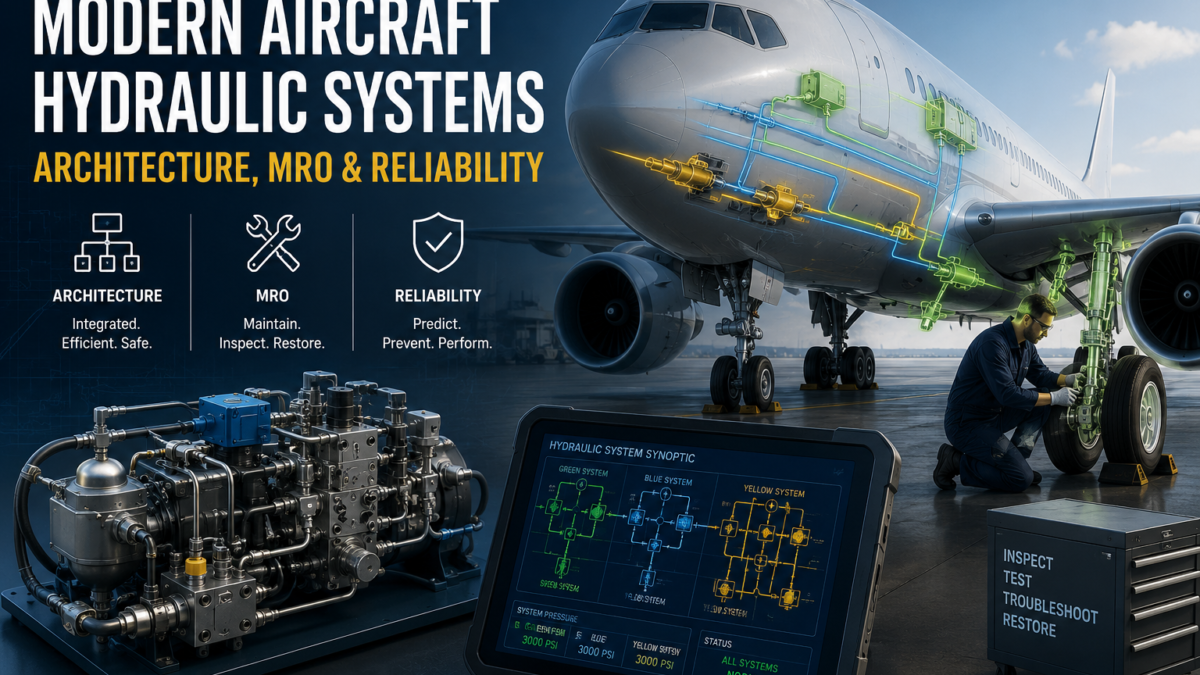
Aircraft hydraulic systems remain the backbone of flight control actuation, landing gear extension/retraction, braking, and nose wheel steering. With the transition from traditional 3,000 psi systems to advanced 5,000 psi architectures on platforms like the Boeing 787 and Airbus A350, the industry has realized significant weight savings and efficiency gains. This comprehensive guide provides technical intelligence on aircraft hydraulic systems for aviation engineers, MRO planners, and fleet managers — covering system architecture, component analysis, failure modes, predictive maintenance, and emerging electrohydrostatic technologies.
1. Hydraulic System Architecture: 3,000 psi vs 5,000 psi Platforms
Modern commercial aircraft employ two primary hydraulic pressure standards. Legacy platforms (B737, A320, B777) operate at 3,000 psi using engine-driven pumps (EDPs) and AC motor pumps. Next-generation aircraft (B787, A350, A380) utilize 5,000 psi systems, enabled by advanced materials, tighter tolerances, and variable-displacement piston pumps. The higher pressure reduces actuator size and hydraulic fluid volume, yielding 30-40% weight reduction for equivalent power output.

| Parameter | 3,000 psi System (Legacy) | 5,000 psi System (Next-Gen) |
|---|---|---|
| Operating pressure | 3,000 ± 200 psi | 5,000 ± 250 psi |
| Typical aircraft | B737NG, A320ceo, B777 | B787, A350, A380, B777X |
| Actuator weight | Baseline | 30-40% lighter |
| Fluid volume | Higher (80-120L) | Lower (50-80L) |
| Hose diameter | Larger | Smaller (weight saving) |
| Pump type | Fixed displacement | Variable displacement |
Key Engineering Insight
The transition from 3,000 to 5,000 psi reduces hydraulic line diameters by approximately 20% and actuator piston areas by 40% for equivalent force output. For a widebody aircraft, this translates to 350-450 kg total system weight reduction, directly improving fuel burn by 0.5-0.8%.
2. Core Components: Pumps, Accumulators, Valves & Actuators
A typical aircraft hydraulic system comprises five primary component categories, each with specific maintenance intervals and failure signatures.
| Component | Function | Typical Life/Interval | Critical Failure Mode |
|---|---|---|---|
| Engine-Driven Pump (EDP) | Primary pressure source | 5,000-8,000 hours | Case drain filter clogging, shaft seal leak |
| Electric Motor Pump (EMP) | Backup/ground ops | 3,000-5,000 hours | Motor winding failure, bearing seizure |
| Accumulator (piston type) | Pressure storage & surge damping | 10 years/overhaul | Nitrogen bladder rupture, pre-charge loss |
| Servo valve | Precise flow control | 20,000+ cycles | Contamination-induced jamming |
| Linear actuator | Flight control movement | 30,000+ cycles | Internal seal wear, external leakage |
| Hydraulic fuse | Fire/leak isolation | Inspect annually | Premature closure |
3. Electrohydrostatic Actuators (EHA): The Power-by-Wire Revolution
Electrohydrostatic actuators represent the most significant innovation in aircraft hydraulic systems since the 1970s. EHAs are self-contained units integrating an electric motor, hydraulic pump, reservoir, and actuator cylinder — eliminating centralized hydraulic plumbing, reservoirs, and distribution lines. The Airbus A380 pioneered EHA for spoilers, while the B787 employs EHAs for backup flight control actuation.
EHA Advantages & Trade-offs
Advantages: 15-25% weight reduction, elimination of centralized hydraulic lines, improved damage tolerance, reduced fire risk, lower maintenance due to fewer leak points, and simplified routing.
Challenges: Higher electronic complexity, thermal management requirements (heat dissipation), higher initial procurement cost, and specialized technician training needs.
4. Hydraulic Fluids: Skydrol, Hyjet, and Next-Generation Formulations
Nearly all commercial transport aircraft use phosphate-ester based hydraulic fluids (Type IV/V) due to their fire-resistant properties. Skydrol LD-4, Skydrol 500B-4, and Hyjet V are industry standards. Key properties include autoignition temperature above 700°C, excellent lubricity, and compatibility with elastomers used in seals and hoses.
| Fluid Type | Applications | Viscosity Index | Key Characteristics |
|---|---|---|---|
| Skydrol LD-4 | B737, A320, B777 | 380 | Low density, wide temp range |
| Skydrol 500B-4 | Legacy Boeing/MD | 350 | Higher viscosity, excellent wear protection |
| Hyjet V | A350, B787 (optional) | 400 | Enhanced thermal stability |
| MIL-PRF-83282 | Military aircraft | 130 | Synthetic hydrocarbon |
5. Failure Mode Analysis & Reliability Metrics
Hydraulic system failures rank among the top three causes of aircraft dispatch delays and AOG situations. The chart below illustrates the relative frequency of failure modes based on industry MRO data (2023-2025).
Predictive Maintenance Implementation
Operators utilizing real-time hydraulic monitoring — including case drain flow sensors, particle counters, and temperature trending — report 35-45% reduction in unscheduled hydraulic maintenance. The B787's health management system automatically predicts pump degradation with 90% accuracy at 200-300 hours before failure.
6. MRO Optimization: Leak Prevention, Fluid Sampling & Overhaul Intervals
Hydraulic system MRO costs typically account for 8-12% of total airframe maintenance expenditure. Optimization levers include: spectrometric fluid analysis (every 500-1,000 flight hours), proactive seal replacement (every 8-10 years), EDP condition monitoring via case drain flow trending, and hose assembly replacement at 10-year intervals regardless of condition.
7. Next-Generation Technologies: 8,000 psi & More Electric Aircraft (MEA)
The aerospace industry is actively researching 8,000 psi hydraulic systems for future ultra-efficient aircraft, potentially reducing actuator weight by an additional 25-30%. Concurrently, the More Electric Aircraft (MEA) concept seeks to replace hydraulic actuators with electromechanical actuators (EMAs) for non-critical functions. However, EMAs face thermal management and jamming risk challenges that currently limit flight control applications.
Industry Outlook (2030-2035)
By 2035, analysts project that 40-50% of new narrowbody aircraft will feature hybrid architectures combining traditional hydraulic systems for high-power functions (landing gear, brakes) with EHAs/EMAs for flight controls. This evolution promises 15-20% reduction in total hydraulic MRO costs while maintaining redundancy and reliability standards.
Frequently Asked Questions (Aircraft Hydraulic Systems)
References & Industry Sources
- FAA Advisory Circular AC 25.1435 - Hydraulic System Design and Installation
- EASA Certification Specifications CS-25 - Hydraulic System Requirements
- SAE AIR 5901 - Aircraft Hydraulic System Design Guide
- Parker Hannifin - Aerospace Hydraulic Systems Technical Manual (2025)
- Eaton - Hydraulic Component Lifecycle Analysis
- Safran Landing Systems - EHA Technology White Paper
- Boeing 787 Aircraft Maintenance Manual (AMM) Chapter 29
- Airbus A350 AMM - Hydraulic Power Systems
- International Air Transport Association (IATA) - Hydraulic MRO Benchmarking Report 2025
Aircraft Hydraulic System Support & MRO Advisory
Safe Fly Aviation supports operators worldwide with hydraulic component sourcing, MRO consulting, technical training, and fleet optimization programs.
Contact Technical Team Call +91 9811673015Conclusion: Strategic Hydraulic System Management
The evolution from 3,000 psi to 5,000 psi architectures, combined with the adoption of electrohydrostatic actuators and predictive maintenance technologies, represents a paradigm shift in aircraft hydraulic system management. Operators who implement condition-based monitoring, proactive seal replacement programs, and technician training on EHA/EMA platforms will realize 20-30% lower hydraulic MRO costs by 2030. The transition to More Electric Aircraft continues, but hydraulic systems will remain essential for high-power actuation for decades to come.
Key Takeaways for Aviation Professionals
- 5,000 psi systems deliver 30-40% weight savings vs 3,000 psi legacy platforms
- Electrohydrostatic actuators eliminate centralized plumbing and reduce leak points
- Predictive fluid analysis reduces unscheduled hydraulic maintenance by 35-45%
- External leakage remains the dominant failure mode (35% of all events)
- EHA/EMA adoption will reach 40-50% of new narrowbody aircraft by 2035