GE90 Engine Family: Engineering & Market Authority | Safe Fly Aviation
GE90 Engine Family: Engineering, Economics & Asset Strategy

📑 Table of Contents
✓ GE90-115B remains the most liquid widebody engine asset with premium residual value.
✓ Major shop visit costs: $6M–$9M; low-risk LLPs drive trading decisions.
✓ Lease rates: $95k–$135k/month for mid-life engines.
✓ Over 100 million flight hours logged; mature aftermarket until 2050+.
Since entering service in 1995, the GE90 engine family has not only powered the Boeing 777 to record efficiency but also shaped engine asset management worldwide. With over 2,800 units delivered and mature fleet dispatch reliability above 99.9%, the GE90 remains the benchmark for large turbofans. For airlines, lessors, and secondary market participants, mastering the GE90's technical progression, maintenance cost drivers, and market liquidity is essential. At Safe Fly Aviation (Safefly.aero), we combine technical depth with global trading networks. This enterprise-grade analysis delivers the intelligence you need.
1. Genesis & Evolution: From GE90-76B to the -115B
Developed exclusively for the Boeing 777, the GE90 program introduced breakthrough technologies: the largest fan diameter (128 inches on -115B), hollow composite fan blades, and a 10-stage high-pressure compressor. Early variants (GE90-76B/77B/85B/90B) offered thrust from 74,000 to 94,000 lbf. The game-changer arrived in 2000 with the GE90-115B, certified at 115,300 lbf — a record that stood for over a decade. The -115B enabled ultra-long-haul twins like the 777-200LR and 777-300ER, becoming the exclusive engine for those types. Today, the GE90 family has logged over 100 million flight hours, with an aftermarket ecosystem that anchors engine trading portfolios.

2. Technical Architecture Defining Reliability
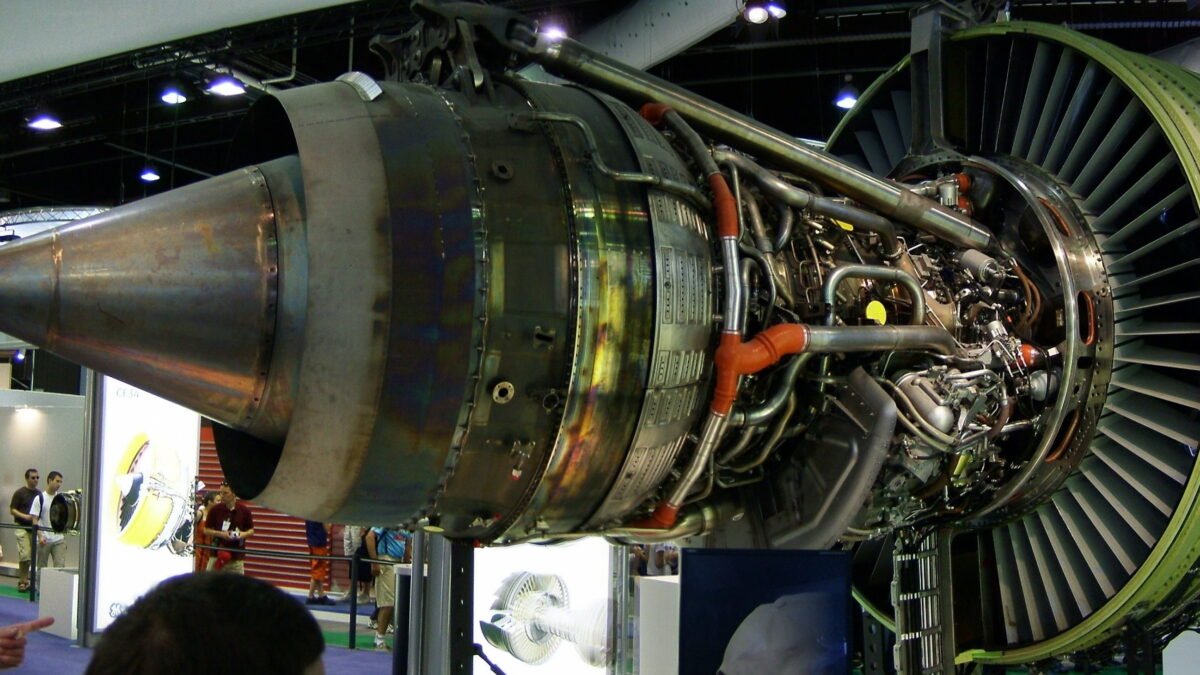
From the fan module to the low-pressure turbine, GE90 design drives both performance and maintainability. The composite fan blades — each crafted from carbon fiber/epoxy — reduce weight while resisting FOD. Swept fan outlet guide vanes cut noise and improve aerodynamics. The modular construction enables robust workscoping, minimizing shop visit downtime. LRU replacements are standardized, which translates into predictable maintenance reserves and strong residual value — key for any engine trading firm.
2.1 GE90-115B Performance Metrics
| Parameter | Value |
|---|---|
| Takeoff Thrust | 115,300 lbf (512 kN) |
| Bypass Ratio | 9.0:1 |
| Overall Pressure Ratio | 42:1 |
| Fan Diameter | 128 inches (3.25 m) |
| Compressor Stages | 1 fan + 3 LP + 10 HP |
| Turbine Stages | 2 HP + 6 LP |
| Typical On-Wing Performance | 20,000–25,000 cycles to overhaul |
3. Maintenance Lifecycle & Cost Reality
For asset managers, the GE90 offers a transparent cost curve. Major shop visit costs typically range from $6M to $9M USD for full performance restoration, while light maintenance (LLP replacement, HPC blade recoating) runs $2.5M–$4M. Life-limited parts (LLPs) such as discs and spools have established replacement intervals, generally 20,000–25,000 cycles. Time between overhaul in high-utilisation fleets average 24 months on-wing. Safe Fly Aviation performs rigorous borescope and records audits before any acquisition, ensuring full transparency.
4. Secondary Engine Trading Ecosystem
With more than 1,200 777s active globally, the GE90 aftermarket is deep and liquid. Dismantling, part-out, and lease returns fuel a vibrant secondary marketplace. The -115B remains a top-tier asset with OEM support through 2050+. Safe Fly Aviation facilitates end-of-lease redelivery, bridge rentals, and outright purchases — providing asset flexibility to operators and lessors worldwide.
5. Comparative Advantage: GE90 vs. Rivals
Over 65% of active 777-300ER frames are GE90-powered, and the -115B has no competitor on 777-300ER/LR. The GE90 commands a 20–30% premium over comparable Trent 800 engines, solidifying its role as the preferred asset for traders.
6. Sustainability & Residual Outlook
With the 777X featuring GE9X (an evolution of GE90 architecture), the GE90 fleet will remain active for 20+ years. Focus on -115B/HB standards ensures longevity, including 777-300ERSF freighter conversions. Supply chain dynamics bolster used serviceable material demand.
7. Best Practices for Trading
Safe Fly Aviation's discipline includes cycle/hour validation, borescope inspections per AMM 72-00-00, LLP remaining life forecasting, and AD/SB compliance negotiation — transforming trades into low-risk, high-yield events.
8. Why Safe Fly Aviation Is Your Trading Partner
Safe Fly Aviation (Safefly.aero) merges technical expertise with global brokerage reach. Our team includes ex-GE propulsion engineers. We provide real-time valuations, leasing structures, and independent asset health reports. Contact us for a confidential consultation.
➡️ Email: trading@safefly.aero | Web: https://safefly.aero
Article last updated: May 2026. Data referenced from OEM manuals and internal market analysis.