Airbus A320 Recall: Solar Radiation Software Flaw Grounds Thousands of Jets, Sparking Global Holiday Travel Chaos
By Safe Fly Aviation News Desk Updated: April 2026 (Original: November 29, 2025)
In late November 2025, Airbus issued a precautionary fleet action affecting approximately 6,000 A320-family aircraft worldwide—roughly half the global in-service fleet at the time. The directive addressed a software vulnerability in the Elevator and Aileron Computer (ELAC) that could potentially be triggered by intense radiation events, such as those associated with solar activity. Operators were required to implement software updates (or, in a smaller number of cases, hardware protections) before the next revenue flight. While the action caused temporary disruptions during the busy holiday travel season, most airlines completed fixes quickly, with minimal long-term impact on operations.
This was one of the largest coordinated precautionary measures in Airbus’s history. It came shortly after the A320 family had overtaken Boeing’s 737 as the most-delivered commercial jet model, with over 12,321 units delivered as of late 2025. By the end of 2025, Airbus had delivered 607 A320-family aircraft that year alone, contributing to a total of 793 commercial deliveries. As of early 2026, total A320-family deliveries stood at approximately 12,512, with around 11,493 aircraft in commercial service across more than 375 operators.
The incident highlighted the growing awareness of space weather risks to aviation electronics, including potential single-event upsets (SEUs) from high-energy particles. Regulators and manufacturers acted swiftly to prioritize safety, and the episode passed without any hull losses or fatalities.
The Trigger: A Mid-Air Event Over the Atlantic
The action stemmed from an October 30, 2025, incident involving JetBlue Airways Flight 1230 (or reported as B6-1174 in some accounts), an A320 en route from Cancún, Mexico, to Newark, New Jersey. While cruising at 35,000 feet, the aircraft experienced a brief uncommanded pitch-down event, resulting in a limited altitude loss (reported around 200 feet in initial accounts, though the autopilot remained engaged and recovered the aircraft). The flight diverted safely to Tampa, Florida, where 15 passengers received treatment for minor injuries, primarily whiplash and anxiety-related issues. No serious injuries or fatalities occurred.
Airbus’s investigation linked the event to potential data corruption in the ELAC system (specifically software version L104 on certain ELAC B hardware) under exposure to intense radiation. While Airbus referenced “intense solar radiation” in its communications, experts later noted that such effects can also result from high-energy cosmic rays, causing single-event upsets—bit flips in electronic memory. No major solar proton event was confirmed exactly on that date, but the vulnerability was real under specific high-radiation conditions.
On November 28, 2025, Airbus issued an Alert Operators Transmission (AOT) recommending immediate action. The European Union Aviation Safety Agency (EASA) and other regulators followed with emergency airworthiness directives. For the majority of affected aircraft (about two-thirds), the fix involved a straightforward software reversion to a prior version, typically taking around two hours. A smaller subset (estimated 1,000–2,000) required additional hardware shielding or deeper work, extending downtime to 24–48 hours in some cases.
At the time, the global A320-family fleet included roughly 11,300 active aircraft (A318/A319/A320/A321 variants), which had collectively accumulated over 176 million flights and 328 million block hours since the type’s 1988 entry into service.
The A320 family’s ubiquity—powering short- and medium-haul routes for low-cost carriers and majors alike—means no operator escapes unscathed. American Airlines, the world’s largest A320 fleet holder with 486 aircraft, confirmed 340 units are impacted. The carrier anticipates completing most updates by November 30 but warns of “limited” delays on high-traffic routes, such as Dallas-Fort Worth to New York LaGuardia.
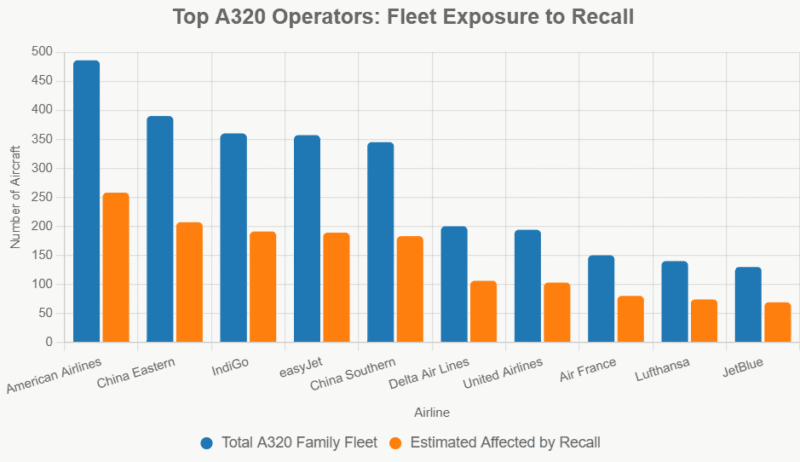
To visualise the scale, here’s a bar chart of the top 10 A320-family operators as of September 2025, highlighting those most exposed to the recall (data sourced from Airbus and Cirium fleet analytics). Note: Estimated affected aircraft assumes ~53% exposure based on the global recall proportion.
-
Airlines in the Crosshairs: Fleet Impacts and Response
The A320 family’s dominance in short- and medium-haul operations meant widespread but manageable effects. Most carriers completed the majority of updates within days, limiting disruptions.
Key operators (approximate A320-family fleet sizes as of late 2025/early 2026 data):
- American Airlines: Largest operator with ~486–489 aircraft; ~340 affected. Completed most work by late November with only limited delays on key routes like Dallas–New York.
- IndiGo (India): ~360–378 aircraft, heavily neo-weighted. Reported minor schedule adjustments on dense domestic routes such as Delhi–Mumbai.
- easyJet: ~356–357 aircraft. Coordinated overnight fixes at European bases with small numbers of cancellations.
- Delta Air Lines: ~200 affected; described impacts as “minimal,” though a handful of flights (e.g., Atlanta–Miami) were cancelled initially.
- United Airlines: ~194 affected; prioritized hub operations with some transcontinental ripple effects.
- Lufthansa Group (across brands): ~140 aircraft; minor cancellations at Frankfurt and Munich.
- Air France: ~150 aircraft.
- JetBlue: ~130 aircraft (incident operator); grounded a portion initially, resulting in over 50 cancellations through early December.
- Others: ANA (Japan) cancelled ~65 flights on November 29; Avianca (Latin America) saw notable disruptions on Bogotá–New York routes; Jetstar (Australia) cancelled dozens of domestic services. Carriers like Azul (Brazil) reported no impact due to different software configurations.
Disruptions were most felt in the U.S. post-Thanksgiving period and in Europe/Asia during peak travel. However, by December 1, 2025, Reuters reported that operations were returning to normal faster than many had feared, thanks to rapid software retrofits.
Operational and Economic Ripples
The timing overlapped with one of the busiest travel periods, including post-Thanksgiving in the U.S. (over 3.5 million passengers screened on November 27) and the global December holiday surge. IATA had projected ~4.7 billion air travelers for 2025 overall.
Airlines already managing Pratt & Whitney engine issues on some A320neos faced added pressure on maintenance slots. Early estimates suggested direct costs in the hundreds of millions for the fixes, with lost revenue from cancellations in the low billions—though the actual impact was mitigated by the speed of compliance. Passenger rights groups called for fee-free rebookings and refunds where applicable, and authorities like the U.S. Department of Transportation provided real-time updates.
On social media, reactions ranged from frustration over delays to wry commentary about “solar flare aviation.” Most travelers experienced only minor inconvenience.

Broader Implications: Safety, Space Weather, and Future Resilience
This event drew comparisons to past issues like the Boeing 737 MAX groundings, but differed significantly: it was isolated, precautionary, and resulted in no accidents—only one minor incident. Airbus’s overall A320-family operational reliability remained exceptionally high at ~99.7% in the preceding period.
It served as a reminder of emerging risks from space weather, particularly during Solar Cycle 25’s active phase (peaking around 2025). High-energy particles can affect avionics, though modern aircraft are designed with significant protections. Airbus committed to further radiation-hardened improvements in future production.
For operators, the episode underscored the value of fleet diversity and robust maintenance planning. Carriers with mixed or all-Boeing narrowbody fleets (e.g., Southwest) avoided direct impact. Long-term, it may accelerate industry focus on radiation-resilient electronics.
As of 2026, the A320 family continues its strong market position with a large backlog and high production rates. Flying remains one of the safest forms of transport, with this vulnerability fully addressed across the fleet.
Safe travels—always check your airline’s app for the latest status, and consider travel insurance during peak periods or known maintenance windows.
Safe Fly Aviation is committed to delivering unbiased, data-driven aviation insights. This update incorporates information from Airbus, EASA, FAA, Reuters, Cirium, and other public sources. Aviation data evolves; always verify with official channels. Grok can make mistakes—cross-check critical details.