Why PT6 and PW127 Engines Are Critical in Island Aviation Networks
PT6 vs PW127: Why These Turboprop Engines Dominate Island Aviation Operations
These turboprop engines offer high reliability, corrosion resistance, short-runway performance, and modular maintenance. They power the majority of regional aircraft serving the Caribbean, Maldives, and Pacific archipelagos, with dispatch reliability consistently exceeding 99.5% in tropical operations.
- PT6: The Legendary Island Workhorse
- PW127: Powering the ATR Fleet
- PT6 vs PW127: Technical Comparison
- Corrosion Management in Saltwater Environments
- Regional Case Studies
- Lifecycle Cost & Maintenance Strategies
- Leasing and Asset Value in Island Markets
- How Safe Fly Aviation Supports Island Operators
- Frequently Asked Questions
Island aviation networks — across the Caribbean, Pacific archipelagos, the Maldives, and Southeast Asia — face unique operational challenges: short runways, corrosive salt spray, high ambient temperatures, and limited maintenance infrastructure. Two engine families have become the backbone of this sector: the Pratt & Whitney Canada PT6 and the PW127. Together, they power a significant proportion of regional turboprops that connect island communities, from the Cessna Caravan to the ATR 72.
The PT6 series (powering Caravans, Twin Otters, King Airs) and the PW127 series (exclusive to ATR 42/72 aircraft) deliver industry-leading dispatch reliability in island operations. Their modular design enables rapid line maintenance, while advanced corrosion-resistant coatings extend on-wing time in salt-laden air. This guide provides verified data, operator case studies, and actionable maintenance strategies.

PT6: The Legendary Island Workhorse
Since its introduction in 1963, the PT6 has become the most widely produced turboprop engine in aviation history, with over 50,000 units manufactured. Its free-turbine design, modular construction, and tolerance to harsh conditions make it the preferred engine for island-hopping operators worldwide.
The PT6's reverse-flow layout places the air intake at the rear, away from the hot section. This design significantly reduces foreign object damage (FOD) ingestion from coral runways, volcanic sand, and unimproved airstrips — a common hazard in remote island destinations.
- Cessna Caravan (PT6A-114A/140): A significant number of Caravans operate in island cargo/passenger roles across the Bahamas, Caribbean, Maldives, and French Polynesia.
- De Havilland Twin Otter (PT6A-27/34): The STOL capability makes it the backbone of inter-island connectivity, particularly in Indonesia and the Maldives.
- Beechcraft King Air (PT6A-52/60): Used extensively for inter-island executive and medevac transport.
PT6 Variants Common in Island Operations
| Variant | Power (SHP) | Typical Aircraft | Primary Island Markets |
|---|---|---|---|
| PT6A-114A | 675 | Cessna 208 Caravan | Caribbean, Maldives, Hawaii |
| PT6A-27 | 550 | Twin Otter | Pacific, Indonesia, Maldives |
| PT6A-60A | 1050 | King Air 350 | Bahamas, Fiji, Philippines |
| PT6A-140 | 867 | Caravan EX | Global island networks |
PW127: Powering the ATR Fleet for Regional Capacity
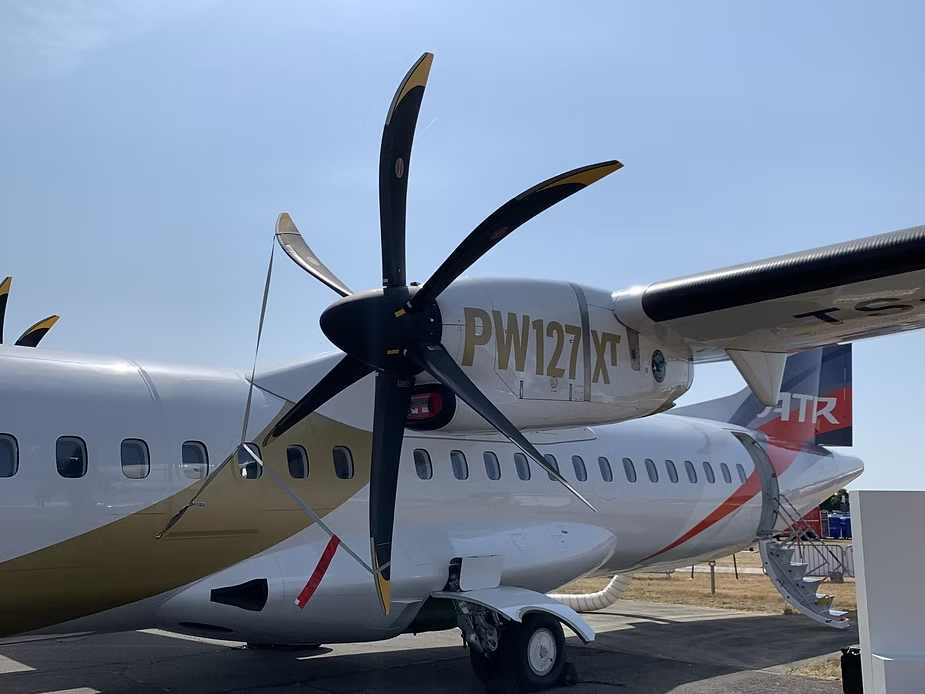
For higher-capacity island routes (48–78 passengers), the PW127 family powers the ATR 42 and ATR 72 — the dominant regional turboprops in island aviation. Over 1,600 ATR aircraft operate worldwide, with a significant percentage serving island and coastal networks. The PW127's five-blade propeller and FADEC provide excellent climb gradients from short runways.
PW127M
2,750 SHP per engine
ATR 72-600: 78 seats, 830 nm range. Operates routes such as San Juan–Santo Domingo and Malé–Gan.
PW127E
2,400 SHP per engine
ATR 42-600: 48 seats, designed for shorter runways. Serves island strips requiring excellent climb performance.

PT6 vs PW127: Technical Comparison
| Metric | PT6 Family | PW127 Family |
|---|---|---|
| Power Range | 500–1,900 SHP | 2,400–2,750 SHP |
| Typical Aircraft | Cessna Caravan, Twin Otter, King Air | ATR 42, ATR 72 |
| Passenger Capacity | 9–19 seats | 48–78 seats |
| Typical Island Routes | Short hops, remote airstrips, cargo | Regional island networks, trunk routes |
| Relative Maintenance Cost | Lower per engine | Higher per engine but lower per seat |
| Corrosion Protection | Sacrificial coatings, corrosion-resistant alloys | Advanced marine environment coatings |
Corrosion Management in Saltwater Environments
Salt spray is a primary concern for aircraft engines in island networks. Both the PT6 and PW127 incorporate advanced corrosion protection features, but proactive management by operators remains essential.
- Daily fresh-water compressor washes – Recommended after each flight day in high-salinity areas.
- Corrosion inhibiting oil formulations – Use of CPI (corrosion preventive) oils during storage or low-utilization periods.
- Regular compressor blade inspections – Operators in tropical marine environments typically increase inspection frequency.
Based on operator feedback from Southeast Asia, compressor blade replacement intervals may be reduced in high-salinity environments compared with inland operations. Safe Fly Aviation recommends accelerated borescope inspections for fleets based in coastal tropical locations.
Regional Case Studies: Real-World Island Operators
Lifecycle Cost & Maintenance Strategies
Island operators often face higher per-unit maintenance costs due to logistics and environmental exposure. However, the PT6 and PW127 offer modular maintenance that reduces downtime. Key strategies:
- Power-by-the-Hour (PBH) programs – Pratt & Whitney Canada's fixed-cost maintenance plans are widely used by island carriers to manage budget uncertainty.
- Hot section inspection (HSI) intervals – Standard intervals per manufacturer manuals. In high-use tropical environments, more frequent borescope inspections are recommended.
- USM (Used Serviceable Material) adoption – LLPs and modules harvested from teardowns provide documented savings of 30–50% compared with new OEM parts.
PT6A Overhaul Cost Range
$280k–$450k depending on variant. Hot section typically $95k–$150k. USM module exchange can reduce downtime by up to 60%.
PW127 Overhaul Cost Range
$1.2M–$1.8M for full overhaul. PBH programs average $220–$280 per flight hour, inclusive of LLP reserves.
Leasing and Asset Value in Island Markets
PT6 and PW127-powered aircraft maintain strong residual value in island regions due to consistent demand. Lease rates for Caravans and ATRs in the Caribbean and Maldives typically command premiums compared with mainland equivalents. Key leasing considerations:
- Corrosion damage clauses – Island leases should include specific return conditions regarding saltwater exposure.
- LLP status tracking – High-cycle operations mean remaining life on hot section components directly affects lease return calculations.
- Engine reserve rates – Industry standard reserves range from $20–$35 per cycle for PT6, $180–$250 per flight hour for PW127.
How Safe Fly Aviation Supports Island Operators
- PT6 & PW127 engine sourcing – Green-time engines and used-serviceable modules for Caravan, Twin Otter, King Air, and ATR fleets.
- Corrosion audit programs – On-site engine borescope and compressor blade assessments for island operators.
- Lease return support – Negotiate fair corrosion wear and tear provisions with lessors.
- USM LLP supply – Certified life-limited parts at 40–60% of OEM new cost, with full 8130-3 traceability.
Island operator? Let's discuss PT6 and PW127 support.
From engine sourcing to corrosion management plans — we help island carriers stay airborne.
Request Island Engine Assessment Source PT6 / PW127 EnginesFrequently Asked Questions
Sources & References
- Pratt & Whitney Canada. PT6A Maintenance Manual (Publication P&WC PT6A-MM, current edition).
- Pratt & Whitney Canada. PW100 Series Engine Documentation and Service Bulletins.
- ATR Aircraft. ATR 42/72 Performance Manual and Island Operations Guide.
- IBA (International Bureau of Aviation). Turboprop Market Report and Fleet Data (2025).
- Cirium Fleet Data. Global turboprop fleet utilization statistics.
- Operator case studies: Trans Maldivian Airways, Manta Air, interCaribbean Airways, Fiji Link.