The History of Aircraft APUs: From Early Innovations to Modern Essentials | Safe Fly Aviation
Aviation Engineering & Technical Insights
The History of Aircraft APUs: From Early Innovations to Modern Essentials
A comprehensive, fact-based engineering guide to how Auxiliary Power Units evolved—from early auxiliary engines and wartime "putt-putts" to today's turbine APUs and more-electric aircraft architectures.
Contents
Aircraft APUs in 60 seconds
What an APU does
Provides onboard electrical power and, on many aircraft, pneumatic (bleed) air for engine starts and cabin conditioning.
Where it sits
Usually in the tailcone, with a small exhaust outlet at the rear of the aircraft.
Why it matters
Faster turnarounds, better comfort on the ground, and improved independence at airports with limited ground infrastructure.
Modern shift
More-electric aircraft architectures place greater emphasis on electrical output from the APU.
What is an APU?
An Auxiliary Power Unit (APU) is a small onboard powerplant—most commonly a compact gas turbine—that provides electrical power and, on many aircraft, pneumatic (bleed) air for engine starting and environmental control. In simple terms, it gives the aircraft independence on the ground and resilience in flight operations.
Quick principle: Fuel + air → turbine → shaft power → generator (electricity) and, where applicable, bleed air for air-conditioning and starts.
A brief history: from precursors to modern essentials
1910s Early auxiliary engines (precursors)
In the First World War era, some large airships used auxiliary engines to drive generators and blowers. These systems were not APUs in the modern, turbine-driven sense, but they represent the earliest push towards independent onboard power.
1940s WWII "putt-putts" and onboard support power
During the Second World War, certain large military aircraft incorporated small piston auxiliary units—often nicknamed "putt-putts"—to provide electrical power and support starts in challenging conditions. Examples include the B-29 Superfortress and C-47 Skytrain. Many aircraft still relied heavily on external ground equipment, but the concept of onboard self-sufficiency accelerated during this period.
Late 1940s Jet starts and the Riedel starter (not an APU)
Early turbojets used compact engine-start solutions such as the Riedel starter for engines like the Junkers Jumo 004. These were engine starters rather than APUs, but they show the shift towards aircraft carrying their own support systems. German engineer Norbert Riedel developed two-stroke flat engines marking a shift to mechanical starters.
1963 Commercial milestone: gas turbine APU in airline service
The Boeing 727 became the first jetliner with a gas turbine APU, enabling reliable starts, cabin conditioning, and electrical supply at airports with limited ground infrastructure. This marked a pivotal moment in commercial aviation, allowing operations at remote airports without ground power.
2000s–today More-electric architectures and smarter maintenance
Modern airliners and business jets typically feature turbine APUs with improved reliability, lower noise profiles, and deeper integration with aircraft health monitoring. The Boeing 787 pioneered electric-only APU configurations, focusing on electrical output for all-electric architectures. More-electric aircraft architectures (notably bleed-less or reduced-bleed concepts) put even greater emphasis on electrical APU capability. Today, APUs are identifiable by tail exhaust pipes on aircraft like the Airbus A380.
Technical diagrams
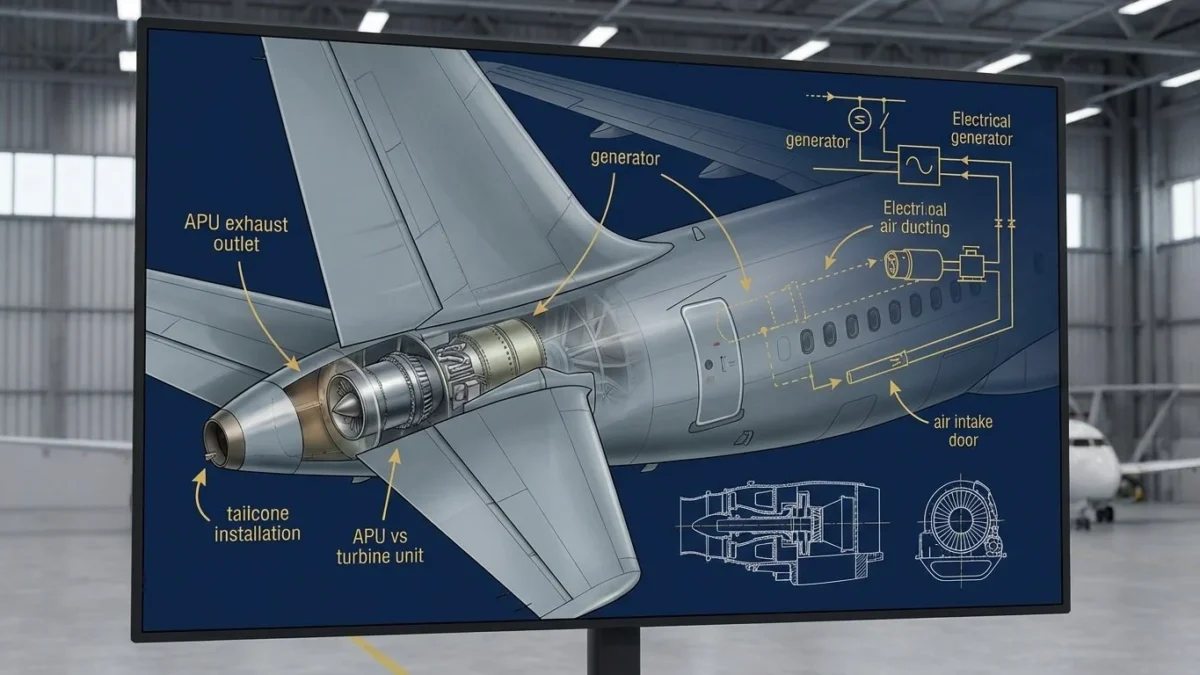
Most airliners and many business jets house the APU in the tailcone, exhausting through a small outlet near the rear fuselage.
APU output is typically electrical and, for many aircraft, also pneumatic. More-electric aircraft rely more heavily on electrical output.
This simplified view explains why electrical APU capability matters more as aircraft systems shift towards electric actuation and electric environmental control.
Types of aircraft APUs: traditional to emerging
Traditional types
- Gas turbine APUs: the global standard for airliners and many business jets; high power density and reliability. Examples include Honeywell's GTCP series.
- Piston auxiliary units (historical): common in WWII-era applications like "putt-putts"; largely obsolete today due to weight and maintenance burden.
Modern and emerging
- Combined electric/pneumatic APUs: standard on most airliners for starts + cabin conditioning.
- Electric-dominant APUs: as in the Boeing 787, focusing on electrical output for all-electric architectures.
- Fuel-cell auxiliary power (experimental): Solid Oxide Fuel Cells (SOFC) under research for quieter, cleaner operation using hydrogen or jet fuel.
- Hybrid/battery-assisted concepts: integrating batteries and electric motors for reduced emissions and lower ground fuel burn.
Comparison tables
Table 1: APU types at a glance
| Type | What it provides | Where you typically see it | Key Manufacturers |
|---|---|---|---|
| Gas Turbine APU | Electricity + (often) bleed air | Commercial airliners, business jets | Honeywell, Pratt & Whitney |
| Piston-Engine APU (historical) | Mainly electricity (varied) | WWII military aircraft | Various (e.g., ABC, Riedel) |
| Electric-Only APU | Primarily electricity, no bleed air | Modern airliners like B787 | Honeywell |
| Fuel Cell APU (experimental) | Electricity (low local emissions) | Future aircraft research | Research (Boeing/Safran) |
| Hybrid / battery-assisted (emerging) | Electricity with peak-load support | Concepts under development | Under development |
Table 2: What an APU can do (practical use cases)
| Function | Why it's valuable | Operational benefit |
|---|---|---|
| Engine starting | Independent starts without external carts (where applicable) | Greater flexibility at remote stands and smaller airports |
| Cabin conditioning | Power for ventilation and air-conditioning on the ground | Improved passenger comfort and faster turnarounds |
| Electrical supply | Avionics, lighting, galleys, cabin systems | Reduced reliance on ground power; resilience during ops |
| Operational independence | Supports dispatch when airport support is limited | More reliable schedules and better on-time performance |
Top APU manufacturers by aircraft programme (verified examples)
The table below lists confirmed APU manufacturer/programme pairings where the aircraft association is explicitly stated by an authoritative manufacturer source. (We avoid unverified “market share” claims and keep this strictly factual.)
| Aircraft programme | Confirmed APU manufacturer | APU model (where stated) | Evidence basis |
|---|---|---|---|
| Airbus A320 Family | Honeywell | 131-9A | Honeywell press release: 131-9A designated standard equipment for A320 family. |
| Airbus A350 XWB | Honeywell | HGT1700 | Honeywell product page: HGT1700 optimised for Airbus A350 XWB. |
| Airbus A380 | Pratt & Whitney Canada | PW980 | Pratt & Whitney / RTX: PW980 specifically designed for the Airbus A380 (largest APU in airline service). |
| Boeing 787 | Pratt & Whitney Canada | APS5000 | Pratt & Whitney (multimedia/APU portfolio): APS5000 listed for Boeing 787. |
Editorial note: Many programmes have multiple options, changes over time, or operator-specific configurations. If you'd like, share the exact aircraft list you want covered (e.g., A330, A220, 777, 737NG/MAX, Gulfstream, Dassault), and we'll only add entries once we have manufacturer-grade confirmation for each programme.
Note: Exact capabilities vary by aircraft type, configuration and operating procedures.
APUs in commercial airliners: powering large-scale operations
In airline service, APUs support fast turnarounds by supplying power for avionics, cabin systems and (where applicable) pneumatic air. They enable quick turnarounds by providing ground power for air conditioning (e.g., "Ground Cooling Mode" on A320neo) and engine starts. They reduce dependence on external ground power units, especially at stands without fixed electrical ground power.
Market leaders include Honeywell (supplying large jets like A350, B777 with approximately 70-80% market share) and Pratt & Whitney (approximately 20-30%, including A380). For regional jets, market shares are more balanced. It's best practice to avoid quoting fixed market-share percentages unless referencing a specific, published dataset; however, it is widely recognised that major OEMs such as Honeywell and Pratt & Whitney supply APUs across a large portion of the global fleet.
APUs in business jets: compact efficiency for private aviation
Business jets feature smaller APUs, often Honeywell's GTCP36 series (commanding 90-100% market share), mounted in the tailcone. They provide similar functions but prioritise weight savings—smaller jets like Cessna Citation CJ may forgo APUs to maximise payload. The priority is high reliability with minimal weight, ensuring the cabin remains fully functional—lighting, galley loads, and environmental comfort—even when airport infrastructure is limited.
Some smaller jets may omit APUs to maximise payload and rely on external ground power instead. For frequent private flyers, an APU often translates into a smoother cabin experience and greater scheduling flexibility. APUs enhance luxury by powering cabins independently.
Future trends in aircraft APU technology: towards sustainability
As aviation pushes for net-zero emissions, APU technology is evolving. The global market is projected to grow from USD 6.11 billion in 2025 to USD 12.48 billion by 2032, driven by electrification and digital integration.
Key trends include:
- Hybrid and Electric APUs: Pratt & Whitney's next-generation APU offers high power density in a compact form, with better integration to more-electric aircraft systems.
- Sustainable Aviation Fuels (SAF) Compatibility: compatibility and operational validation with SAF where applicable, reducing carbon footprint.
- Fuel Cell Integration: SOFCs (Solid Oxide Fuel Cells) for quieter, emission-free ground power (still developmental).
- Digital Diagnostics: mobile-first tools for maintenance, adopted in 42% of MROs. Predictive maintenance, smarter fault isolation, and reduced downtime.
- Electrification: higher electrical output supporting all-electric environmental control systems.
Editorial caution: Market size forecasts and adoption percentages vary widely across sources. Figures should be verified against published industry reports.
Frequently asked questions
What is an aircraft APU?
An Auxiliary Power Unit (APU) is a small onboard powerplant—most commonly a compact gas turbine—that provides electrical power and, on many aircraft, pneumatic (bleed) air for engine starting and environmental control. It gives the aircraft independence on the ground and resilience in flight operations.
Is the Riedel starter an APU?
No. The Riedel starter is best described as a compact engine starter used on some early turbojet engines. It helped start the main engines but did not function as a dedicated auxiliary power unit supplying aircraft-wide electrical and pneumatic services like modern APUs.
Why are most APUs located in the tail?
The tailcone location typically helps with packaging, exhaust routing, noise management, and separation from the cabin and main engines. Exact design choices depend on aircraft architecture.
Do modern aircraft still use gas turbine APUs?
Yes—gas turbine APUs remain the most common solution. Even more-electric aircraft typically still use a turbine APU, but the output emphasis may shift more towards electrical power rather than bleed air.
Can an aircraft operate without an APU?
In some cases, yes—aircraft can rely on external ground power and air-start equipment. However, an APU significantly improves operational independence, especially at remote airports or during irregular operations.
What is the difference between electric-only and combined APUs?
Electric-only APUs (like those on the Boeing 787) focus exclusively on electrical power generation, supporting more-electric aircraft architectures. Combined APUs provide both electrical power and pneumatic bleed air for engine starting and environmental control systems, common on traditional airliners.
What are your thoughts on emerging APU innovations? Contact Safe Fly Aviation for technical consultations and aviation advisory services.