Dangerous Goods by Air | IATA DGR & ICAO Compliance Guide |
Dangerous Goods by Air

1. What Are Dangerous Goods?
According to IATA DGR, dangerous goods (also known as hazardous materials or DG) are articles or substances which, when transported by air, are capable of posing a significant risk to health, safety, property, or the environment. These materials require specific handling, packaging, documentation, and training to ensure safe transport.
Examples of common dangerous goods shipped by air include lithium batteries (in electronics), paints and adhesives (flammable liquids), medical oxygen cylinders (gases), dry ice (used as a refrigerant), perfumes and aerosols, and industrial chemicals. Understanding classification is the first step toward compliance — and toward a charter booking that clears customs and ramp handling without delay.
Over 1.25 million DG shipments are transported by air annually. Lithium batteries represent the fastest-growing DG category. IATA DGR is updated annually, effective January 1 each year, and non-compliance penalties can be substantial under FAA and EASA enforcement regimes — get your classification checked before you book capacity.
2. Regulatory Framework – ICAO & IATA
Two primary documents govern dangerous goods by air:
- ICAO Technical Instructions for the Safe Transport of Dangerous Goods by Air: the international baseline standard adopted by all ICAO member states, legally binding under the Chicago Convention.
- IATA Dangerous Goods Regulations (DGR): incorporates the ICAO Technical Instructions with additional, stricter airline-specific requirements. The practical guide used by shippers, forwarders, and carriers worldwide, updated annually.
National aviation authorities — the FAA in the US, EASA in Europe, the DGCA in India, and the GCAA in the UAE, among others — enforce these regulations and may impose additional restrictions. Operators must also comply with their own Operations Specifications (OpSpecs) approved by their national authority, which is one reason an experienced charter broker with multi-jurisdiction operating experience matters for cross-border DG movements.

3. The 9 Classes of Dangerous Goods
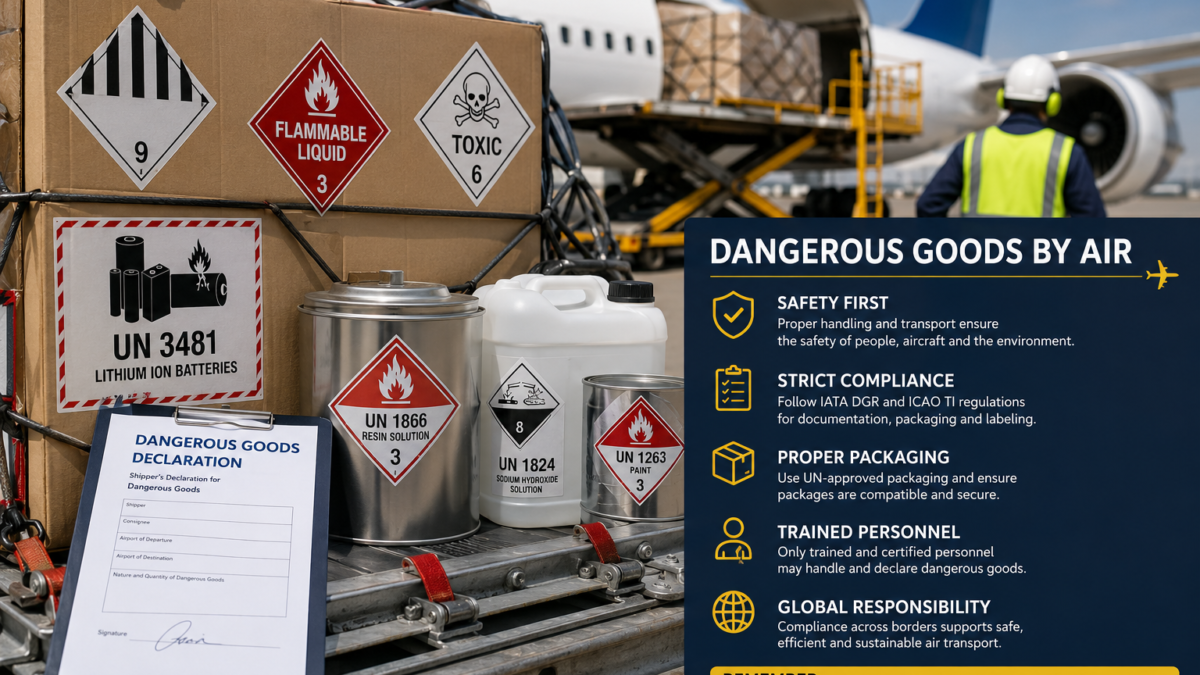
IATA DGR divides dangerous goods into 9 hazard classes. Each class has distinct risks and handling requirements:
| Class | Description | Examples | Common UN Numbers |
|---|---|---|---|
| Class 1 | Explosives | Fireworks, ammunition, detonators | UN0351, UN0027 |
| Class 2 | Gases | Oxygen cylinders, propane, aerosols | UN1072, UN1956 |
| Class 3 | Flammable Liquids | Paints, adhesives, perfumes, fuels | UN1263, UN1993 |
| Class 4 | Flammable Solids | Matches, sulfur, activated carbon | UN1944, UN1350 |
| Class 5 | Oxidizers & Organic Peroxides | Hydrogen peroxide, fertilizers | UN2014, UN3109 |
| Class 6 | Toxic & Infectious Substances | Medical waste, biological samples, pesticides | UN2814, UN3373 |
| Class 7 | Radioactive Materials | Medical isotopes, industrial gauges | UN2915, UN3332 |
| Class 8 | Corrosives | Battery acid, drain cleaners | UN2796, UN3264 |
| Class 9 | Miscellaneous | Lithium batteries, dry ice, magnetized materials | UN3480, UN3481, UN1845 |
Important note: many substances have multiple hazards and are assigned a primary and subsidiary hazard class. Lithium batteries (Class 9) are currently the most scrutinized DG category due to fire risk.
4. Packaging Requirements & UN Specifications
Dangerous goods must be packaged in UN-certified packaging that has passed rigorous performance tests. Under IATA DGR Section 6, packaging must:
- Bear UN specification markings (e.g. “1A1/Y1.4/150/22/USA/M1234”)
- Be chemically compatible with the hazardous material
- Meet performance standards for stacking, vibration, drop, and pressure tests
- Include appropriate inner packaging and absorbent or cushioning material
- Be closed according to the manufacturer's specifications
1A1 = steel drum, removable head · Y = Packing Group II · 1.4 = max gross mass (kg) · 150 = hydraulic test pressure (kPa) · 22 = year manufactured · USA = country of certification · M1234 = manufacturer code.
5. Marking, Labeling & Documentation
Every dangerous goods shipment requires three layers of communication:
Marking (on the package)
- UN number (e.g. UN3480 for lithium ion batteries)
- Proper shipping name (e.g. “Lithium ion batteries”)
- Shipper and consignee name and address
- Net quantity per package
- “Overpack” marking, if applicable
Labeling (hazard communication)
- Primary hazard label (diamond, 100×100mm, colour-coded by class)
- Subsidiary hazard label, if applicable
- Cargo Aircraft Only label, for items forbidden on passenger aircraft
- Lithium battery handling label, for cells and batteries
Documentation
- Shipper's Declaration for Dangerous Goods (DGD): the IATA form certifying the shipment complies with regulations, signed by trained personnel.
- Air Waybill (AWB): includes a “Dangerous Goods” notation and indicates if the shipment is “Cargo Aircraft Only.”
- Packing List: detailed contents with DG information.
6. Lithium Batteries – Special Restrictions
Lithium batteries (rechargeable ion and non-rechargeable metal) are classified as Class 9 dangerous goods and are subject to the strictest current regulations, due to thermal-runaway fire risk:
| Battery Type | UN Number | Passenger Aircraft | Cargo Aircraft | Special Conditions |
|---|---|---|---|---|
| Lithium ion (rechargeable) | UN3480 | Prohibited | Permitted (Section IA/IB) | ≤30% state of charge, specific packaging |
| Lithium ion in equipment | UN3481 | Permitted (limits apply) | Permitted | Must be protected from damage |
| Lithium metal (non-rechargeable) | UN3090 | Prohibited | Permitted | Strict quantity limits |
| Lithium metal in equipment | UN3091 | Permitted (limits apply) | Permitted | Equipment must be packaged securely |
State of charge must not exceed 30% for UN3480 shipments · each cell or battery must pass UN38.3 testing · packages must withstand a 1.2m drop test · the “Cargo Aircraft Only” label is required for UN3480/UN3090 · shippers must retain test data for each battery type.
7. Training Requirements for Shippers & Handlers
IATA DGR Section 1.5 mandates dangerous goods training for all personnel involved in preparing, offering, accepting, or handling dangerous goods shipments. Key requirements:
- Initial training: complete before performing any DG function.
- Recurrent training: every 24 months minimum — many organisations require annual refreshers.
- Function-specific training: shippers, packers, loaders, and acceptance staff each have distinct requirements.
- Documentation: training records must be retained, typically for 36 months after employment ends.
- Certification: an IATA DGR certificate is issued on completion, valid for 24 months.
Safe Fly Aviation maintains IATA-certified dangerous goods specialists on staff for all cargo charter operations, and can also advise shippers on their own compliance requirements.
8. Safe Fly Aviation – Your DG-Compliant Charter Partner
Safe Fly Aviation arranges specialised dangerous goods transport for cargo charter clients worldwide. Our desk covers:
- DG-compliant aircraft: charter capacity positioned for dangerous goods transport across Class 1–9 (subject to explosives restrictions).
- Certified personnel: IATA-trained dangerous goods specialists and loadmasters.
- Full-service documentation: DGD preparation, AWB processing, and customs clearance coordination.
- Lithium battery expertise: UN38.3 testing support, packaging sourcing, and compliance verification.
- Global coverage: DG-capable charter aircraft arranged worldwide, coordinated 24/7.
- Consulting services: training, compliance audits, and packaging advisory.
Frequently Asked Questions
Need Dangerous Goods Transport by Air?
Contact Safe Fly Aviation for DG-compliant cargo charter, full documentation support, and compliance consulting — available 24/7.
Regulatory figures and citations above are provided for general guidance; always confirm current-year requirements with IATA, ICAO, and your national aviation authority before shipping.