

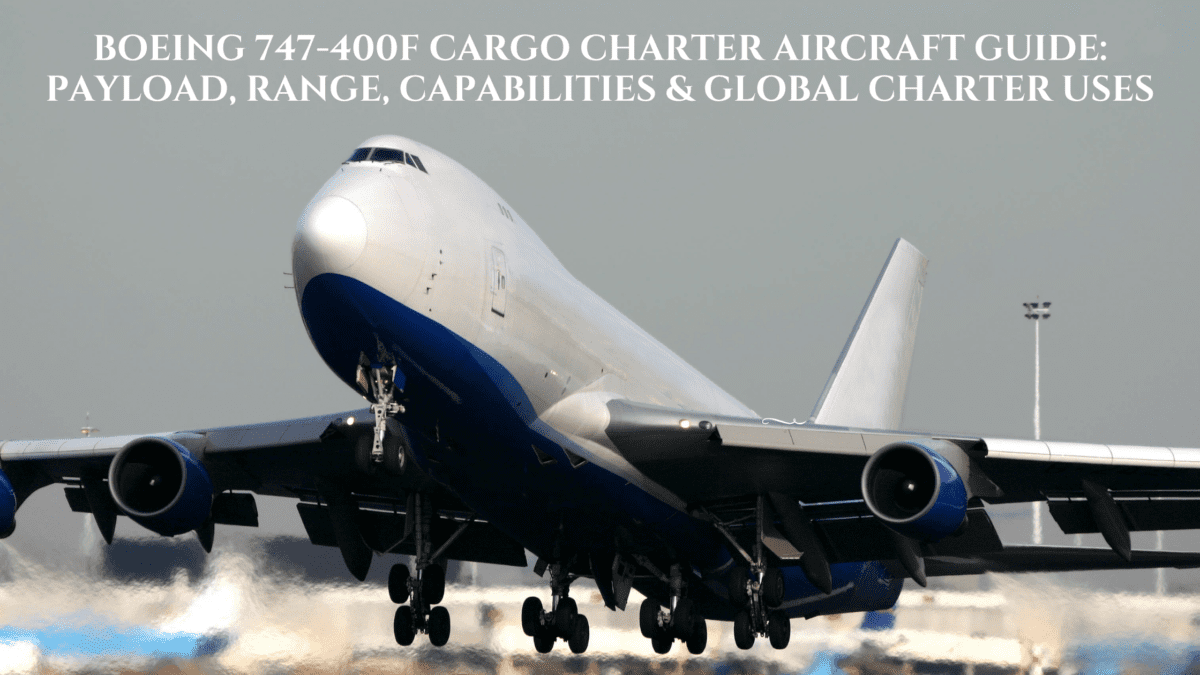
Boeing 747-400F Cargo Charter Aircraft Guide: Payload, Range, Capabilities & Global Charter Uses
The Boeing 747-400F remains one of the most powerful and versatile cargo aircraft operating in global charter logistics today. Designed specifically for high-volume freight transport across intercontinental distances, this aircraft continues to support industries ranging from aerospace and automotive manufacturing to pharmaceuticals and energy infrastructure — and it plays a central role in Safe Fly Aviation’s heavy cargo charter operations worldwide.

Why the Boeing 747-400F Is One of the World’s Most Requested Cargo Charter Aircraft
The short answer: The Boeing 747-400F combines exceptional payload capacity, intercontinental range, and a unique forward nose-door loading system in a single aircraft platform. This combination makes it the preferred choice for cargo missions involving heavy industrial equipment, oversized aerospace structures, or high-volume freight that must cross continents on a fixed deadline. No other widebody freighter matches all three capabilities simultaneously.
At Safe Fly Aviation, the Boeing 747-400F plays a critical role in supporting heavy cargo charter missions worldwide — especially when shipments are oversized, time-critical, or require direct point-to-point routing between continents without intermediate handling stops that risk cargo integrity or delay delivery.
The aircraft’s legacy as the definitive heavy freighter stretches back decades, but its relevance has only increased in 2026. As just-in-time manufacturing networks have grown more global and supply chains more fragile, the ability to move a 90-tonne consignment from Shanghai to Frankfurt overnight — or a 120-tonne industrial structure from Houston to Doha — has become a strategic capability rather than an edge case. The 747-400F delivers that capability reliably and at scale.
Payload capacity exceeding 110 metric tons
Long-range intercontinental routing capability
Nose-door loading for oversized and extra-long cargo
Main deck palletised cargo configuration
Side cargo door loading flexibility
Efficient high-volume freight transport
Up to 30 main-deck pallet positions
Lower deck containerised cargo capacity
These features allow logistics planners to transport cargo that cannot be accommodated on most other widebody freighter aircraft — giving the 747-400F a role no other platform can fully replicate.
Boeing 747-400F Technical Specifications
The Boeing 747-400F is a dedicated freighter variant of the 747-400 family, featuring a strengthened main deck floor, no passenger windows, and a nose-door loading system that differentiates it from passenger-to-freighter conversions. The specifications below reflect typical operator configurations used in commercial cargo charter operations.
| Specification | Details |
|---|---|
| Maximum Payload | Approx. 112–130 metric tons |
| Maximum Range (Full Payload) | Approx. 8,200 km |
| Main Deck Cargo Volume | Approx. 670 cubic meters (total) |
| Main Deck Pallet Positions | Up to 30 positions (96″ × 125″ pallets) |
| Lower Deck Capacity | LD-1 and LD-3 containers + bulk compartment |
| Nose Door Access | Yes — full nose-door swing loading |
| Side Cargo Door | Yes — forward main deck side door |
| Cruise Speed | Mach 0.85 (approx. 900 km/h) |
| Maximum Take-Off Weight | Approx. 412,775 kg |
| Wing Span | 64.4 metres |
| Powerplant | 4 × General Electric CF6-80C2 or Pratt & Whitney PW4000 |
| Typical Charter Operators | Atlas Air, Cargolux, Lufthansa Cargo, Korean Air Cargo, Air Charter Service |
The 112–130 metric ton payload range reflects variation between operator configurations and structural modification status. For mission planning purposes, Safe Fly Aviation confirms precise payload availability for each aircraft sourced through our operator network, ensuring the selected platform meets your specific cargo weight and volumetric requirements before any commitment is made.
Advantages of Nose-Door Loading on the Boeing 747-400F
What is nose-door loading? The Boeing 747-400F features a forward-opening nose door that allows the entire nose section to swing upward, creating a straight-through loading path from the front of the aircraft onto the main deck. This is unique among widebody freighters and enables transport of extra-long, irregularly shaped, or rigid structures that cannot be loaded through conventional side cargo doors.
The Nose Door Advantage — What No Other Widebody Freighter Offers
On most freighter aircraft, cargo enters through a side cargo door located partway along the fuselage. This limits the length of individual pieces to the internal width of the cargo hold — typically around 6 to 7 metres for standard widebody freighters. The 747-400F’s nose-door system removes this constraint entirely.
With the nose swung open, cargo can be loaded straight onto the main deck from the aircraft’s nose — allowing individual pieces of up to approximately 13 metres in length to be accommodated on the main deck. This is why the 747-400F is the default choice for aerospace component transport, industrial machine relocation, and project cargo missions where individual items simply cannot be disassembled to fit conventional cargo doors.
Loading of extra-long cargo pieces up to ~13 metres
Transport of industrial machinery in assembled form
Accommodation of aerospace structures and engine nacelles
Improved loading speed and flexibility for project cargo

Few cargo aircraft worldwide offer this level of oversized freight accessibility. The Antonov An-124 is the primary alternative for the very largest outsized structures, but for most industrial and aerospace charter missions falling in the 60–120 tonne range, the 747-400F’s combination of nose-door access, payload strength, and global operator availability makes it the preferred platform.
What Makes the Boeing 747-400F Ideal for Cargo Charter Missions
The Boeing 747-400F is widely used in global charter logistics because it combines volume, payload strength, and loading flexibility within a single aircraft platform — the full trifecta that most heavy cargo missions require. Logistics planners frequently specify the 747-400F when shipments combine high weight, significant volume, and tight delivery timelines that rule out multi-leg routing via smaller freighters.
“The 747-400F is particularly valuable when transporting cargo that no other widebody freighter can accommodate at the required weight, volume, and timeline simultaneously.”
The aircraft is particularly valuable for: aerospace components including engines and landing gear assemblies, industrial machinery including press tools and manufacturing equipment, oil & gas equipment including turbines and pipeline sections, automotive production parts at urgent timescales, humanitarian relief cargo including medical equipment and shelter structures, military support equipment, and pharmaceutical shipments requiring temperature management across intercontinental routes.
| Shipment Requirement | Why 747-400F Works Best |
|---|---|
| Oversized or extra-long cargo | Nose-door loading — straight-through main deck access |
| Heavy industrial equipment (60–120t) | Highest payload of any commercial freighter |
| Intercontinental direct routing | 8,200 km range eliminates intermediate stops |
| Emergency production support cargo | Rapid deployment through global operator network |
| Large humanitarian cargo missions | High-volume capacity with priority routing |
| Aerospace AOG component transport | Engine and structure accommodation via nose door |
| Multi-pallet high-volume consignments | 30 main-deck pallet positions plus lower deck |
Industries That Commonly Charter Boeing 747-400F Aircraft
The 747-400F serves industries where weight, volume, and dimensional constraints eliminate all other widebody freighter options. Below are the primary sectors that depend on the 747-400F for mission-critical cargo charter.
Aircraft engines, fuselage components, landing gear assemblies, and maintenance equipment frequently require widebody cargo platforms for transport between global MRO facilities. The 747-400F’s nose-door is essential when engine nacelles or wing sections cannot be disassembled to fit conventional cargo doors.
- AOG engine transport worldwide
- Landing gear assembly relocation
- Fuselage and wing section transport
- MRO equipment and tooling movements
- Avionics and aircraft systems shipping
Production-line-critical components such as gearboxes, press tooling systems, semiconductor wafers, and emergency spare parts are transported using 747-400F charters to prevent factory shutdowns — where the cost of a single production hour typically exceeds the charter premium.
- Urgent spare parts to prevent line stoppage
- Press tooling and die transport
- Semiconductor and electronic components
- Prototype vehicle component movement
- EV battery system transport (DGR Class 9)
Heavy turbines, pipeline components, drilling equipment, and specialised tools can be transported efficiently using the aircraft’s large payload capacity and direct routing capability. For energy projects in remote locations, avoiding multi-leg routing is critical to maintaining project timelines.
- Gas turbine and generator sets
- Pipeline inspection equipment
- Drilling systems and BOP equipment
- Power transmission and transformer units
- Subsea infrastructure components
Large-volume relief cargo shipments — including emergency shelters, field hospital equipment, water purification systems, and disaster response supplies — benefit from the aircraft’s ability to deliver significant payloads quickly across continents with minimal intermediate handling.
- Emergency medical equipment deployment
- Field hospital structures and supplies
- Water purification and sanitation systems
- Emergency food and non-food item (NFI) shipments
- Disaster response vehicle transport
High-volume pharmaceutical shipments — including vaccine consignments, bulk pharmaceutical ingredients, and medical device equipment — use the 747-400F when both volume and temperature management across long intercontinental routes are required simultaneously.
- High-volume vaccine distribution
- Active pharmaceutical ingredient (API) bulk transport
- Medical imaging and diagnostic equipment
- Surgical equipment and hospital supplies
- Cold-chain cargo with GDP compliance
Military and government logistics operations frequently require the transport of outsized equipment, vehicles, and systems under time-critical conditions. The 747-400F’s payload capacity and nose-door loading make it suitable for a wide range of defence and government charter missions.
- Military vehicle and equipment transport
- Government strategic stockpile movement
- Defence contractor component logistics
- Emergency government cargo deployment
- Infrastructure support equipment
Typical Boeing 747-400F Cargo Charter Routes
The Boeing 747-400F’s 8,200 km range at full payload allows operators to fly intercontinental routes directly without refuelling stops — saving typically 6 to 18 hours compared to multi-leg routing via smaller freighters. This makes it the preferred platform for time-critical cargo that must cross Asia, Europe, or the Americas without intermediate handling.
Its long-range capability allows operators to reduce intermediate stops — saving both time and cargo handling risk. Every additional landing and cargo transfer introduces handling exposure, temperature fluctuation for cold-chain cargo, and potential for delay. The 747-400F eliminates these risks on routes that smaller freighters cannot cover direct.
Boeing 747-400F vs Other Widebody Cargo Aircraft
Choosing the right freighter platform requires matching the aircraft’s payload, range, and loading configuration to the shipment’s specific requirements. The table below compares the 747-400F to its primary alternatives in the widebody freighter market.
| Aircraft | Payload Strength | Oversized Cargo Capability | Best Use Case |
|---|---|---|---|
| 747-400F This Aircraft | Very High — up to 130t | Excellent — nose-door loading | Heavy & oversized industrial cargo |
| Boeing 777F | High — up to 103t | Limited — no nose-door | Long-range express cargo |
| Airbus A330-200F | Medium-High — up to 70t | Moderate | Regional heavy cargo |
| Boeing 767-300F | Medium — up to 55t | Limited | Mid-range logistics routes |
| Antonov An-124 | Ultra Heavy — up to 120t+ | Maximum — nose & rear door | Project & super-outsized cargo |
For most heavy industrial charter missions in the 60–120 tonne range, the 747-400F is the optimal choice. The Antonov An-124 is selected for the very largest outsized structures. The Boeing 777F is chosen when payload is below 100 tonnes and fuel efficiency is the priority over oversized loading access.
How Safe Fly Aviation Supports Boeing 747-400F Cargo Charter Missions Worldwide
Through its global operator network, Safe Fly Aviation provides access to Boeing 747-400F aircraft for a wide range of cargo charter missions requiring heavy-lift capability and long-range routing flexibility. We do not operate a fixed fleet — instead, we source the right aircraft from certified operators globally, matching each mission to the platform that best meets its specific payload, dimensional, and timeline requirements.
“Safe Fly Aviation’s cargo charter coordination covers everything from aircraft sourcing to customs clearance — so your team manages the business, not the logistics.”
Our coordination for Boeing 747-400F missions includes aircraft sourcing across our global operator network, route feasibility and permit planning, ground handling coordination at origin and destination, oversized cargo load planning and weight and balance calculation, customs clearance documentation and pre-arrival coordination, and door-to-door multimodal logistics support where required.
Arranging a Boeing 747-400F Cargo Charter — Step by Step
Arranging a heavy cargo charter flight is straightforward when shipment details are available early in the process. The more information provided at enquiry stage — dimensions, weight, loading method requirements, origin and destination airports, delivery timeline, and special handling needs — the faster a confirmed quotation can be provided. Safe Fly Aviation typically quotes within 90 minutes of receiving complete cargo details.
For additional cargo aircraft solutions including the Antonov An-124, Boeing 767-F, and Airbus widebody platforms, explore our full cargo charter aircraft guide. For full mission planning guidance, see our how to book a cargo charter flight guide.
The Boeing 747-400F in Global Cargo Charter — 2026 and Beyond
The Boeing 747-400F’s position in the global cargo charter market remains strong in 2026. Despite the introduction of newer long-haul freighters such as the Boeing 777F and Airbus A350F, no production aircraft has replicated the 747-400F’s unique combination of payload capacity, nose-door loading access, and global operator availability. For oversized and heavy cargo missions, it remains without a direct competitor in its class.
The growth of e-commerce, near-shoring of manufacturing, and increased pharmaceutical supply chain investment are all increasing demand for the kind of high-capacity, direct-routing cargo missions the 747-400F was built to perform. As geopolitical pressures continue to disrupt scheduled freight networks, the aircraft’s role as a strategic logistics platform — deployable at short notice by companies that need to bypass disrupted routes — will only become more significant.
Safe Fly Aviation continues to maintain access to Boeing 747-400F capacity through our global operator network, ensuring that clients who need this platform for urgent, oversized, or intercontinental cargo missions can access it quickly — typically within hours of an initial enquiry.
Boeing 747-400F Cargo Charter — Questions & Answers
Common questions about the Boeing 747-400F for cargo charter operations, answered for logistics managers, procurement teams, and supply chain professionals.
The Boeing 747-400F has a maximum payload capacity of approximately 112 to 130 metric tons depending on operator configuration. Its main deck can accommodate up to 30 palletised pallet positions plus lower deck LD-1 and LD-3 containers, giving a total cargo volume of approximately 670 cubic meters. Safe Fly Aviation confirms precise payload availability for each operator-specific aircraft before commitment.
The Boeing 747-400F has a range of approximately 8,200 kilometres at full payload. This makes it capable of intercontinental direct routing from Asia to Europe, Middle East to Africa, and India to North America without intermediate refuelling stops when payload is optimised — saving typically 6 to 18 hours and multiple handling exposures compared to multi-leg routing via smaller freighters.
The Boeing 747-400F features a forward-opening nose door that allows the entire nose section to swing upward, creating a straight-through loading path for extra-long or irregularly shaped cargo. This is unique among commercial widebody freighters and enables transport of aerospace structures, industrial machinery, and oversized equipment — including items up to approximately 13 metres in length — that cannot enter through conventional side cargo doors.
The Boeing 747-400F offers higher maximum payload capacity (up to 130 metric tons vs the 777F’s approximately 103 metric tons) and nose-door access for oversized cargo, which the 777F does not have. The Boeing 777F offers greater fuel efficiency on ultra-long haul routes where payload is below 100 tonnes. For heavy industrial and oversized cargo charter missions, the 747-400F is generally the preferred platform.
The Boeing 747-400F is used across aerospace and aviation (AOG parts, engine transport, fuselage structures), automotive manufacturing (production-critical components, press tooling, semiconductors), energy and infrastructure (turbines, drilling equipment, pipeline sections), humanitarian relief (high-volume emergency cargo), pharmaceutical logistics (high-volume vaccine and API consignments), and military and government support operations.
Contact Safe Fly Aviation at info@safefly.aero or call +91 78400 00473. Provide your cargo dimensions and weight, origin and destination airports, required delivery timeline, loading method requirements, and any special handling needs. Safe Fly Aviation typically provides a quotation within 90 minutes and operates 24/7 to support urgent cargo missions including AOG and humanitarian deployments.
Yes. The Boeing 747-400F can carry dangerous goods across IATA DGR categories subject to operator approvals, quantity limitations, and specific packing, labelling, and documentation requirements. Commonly transported DGR categories include lithium batteries (Class 9), flammable liquids (Class 3), and infectious substances (Class 6.2). Safe Fly Aviation coordinates full IATA DGR compliance — including Shipper’s Declaration preparation and operator approval verification — as part of every dangerous goods charter mission.
Ready to Charter a Boeing 747-400F?
If your shipment requires high-capacity transport, nose-door oversized loading, or intercontinental routing flexibility — Safe Fly Aviation’s cargo charter specialists are available 24 hours a day, 7 days a week.